Category Archives: New Releases

“What Took You So Long…?”

There’s an old Yiddish saying that translates to: “Man plans, and God laughs.” Boyohboy, did the Writing Gods yuck it up at my expense.

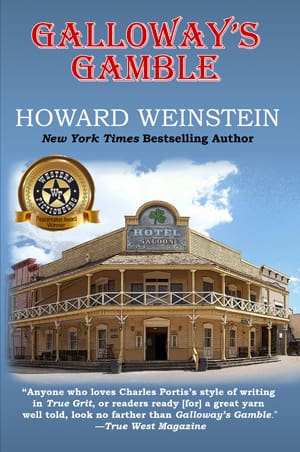
FLASHBACK: Things were going swimmingly for me in September 2017. My new book Galloway’s Gamble had just been published by Western-historical fiction specialist Five Star Publishing, and (after four decades writing lots of Star Trek and other science fiction) my very first historical novel also won a Western Fictioneers Peacemaker Award—a little icing on the cake.  

When my Five Star editors asked for more stories about endearingly argumentative brothers Jamey and Jake Galloway, I thought I’d won the writer’s lottery! I’d stumbled into a new storytelling niche I loved. I was embarking on my very own novel series. And I believed I’d found a happy publishing home for the rest of my writing days.  

But . . . “Man plans, and God laughs.”

Right around the time Galloway’s Gamble came out, I started having back problems that would keep me from sleeping for the next four years (which ain’t good for the brain). After twenty different medical practitioners, umpteen different drugs, and back surgery all failed to help; I’d lost four productive years and counting (although many people suffer far worse misfortune than I did). 

Speaking of which, there was also that disruptive little pandemic thing.

Then a tiny miracle happened—no thanks to all those doctors, I accidentally discovered a prescription drug combo which actually enabled me to get some sleep (and hasn’t caused alarming side-effects, like growing a second head or third arm . . . yet). I was able to resume making slow, steady progress on Galloway’s Gamble 2 and finally finished it—YAAAAAY!!!—only to learn that Five Star was being shut down by its parent company after 27 years of publishing award-winning fiction. Noooooo!

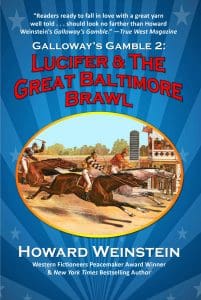
Faced with the reality that few other publishers (the kind that actually pays their writers, anyway) are doing this kind of book, I made the decision many fellow writers have also made—to self-publish. So that’s how I and Galloway’s Gamble 2: Lucifer & The Great Baltimore Brawl ended up at Crazy 8 Press, the writers’ collective I helped found a dozen years ago. Galloway’s Gamble 2 is the second book from Crazy 8’s new Western-historical imprint Silverado Press.

While science fiction has to be plausible, historical fiction has to be accurate. So, once I decided to write about 19th-century horse racing–America’s first true national sport, about which I knew very little—I dove into research. Not only did I learn lots of mundane details needed to give this tale authenticity, I also found some brilliant gold nuggets that enriched the entire story. 

When I read about millionaire horseman James Ben Ali Haggin, whose plan to enter a long shot stallion in the 1886 Kentucky Derby and collect a betting windfall was upended by a bookmakers strike, the legendary 1877 Great Sweepstakes match race at Pimlico, which drew nationwide attention; and the 19th-century dominance of Black jockeys, I knew I had the recipe for a tasty Galloway’s Gamble 2 stew worth cooking.

So what’s the story? After their friends are swindled out of a champion racehorse by ruthless rival Cortland Van Brunt III in a fog-shrouded San Francisco sprint, Jamey and Jake Galloway lead the gang on a snakebit, obstacle-strewn transcontinental quest: Can they reach Baltimore in time for a desperate long-shot bid to win back prized stallion Phoenix in a grudge-match race at Pimlico?

And that’s what took me so long.

But I’m happy to report that Galloway’s Gamble and Galloway’s Gamble 2 are available in paperback and ebook editions from Amazon.com. Both are fast, fun reads, and I hope even readers who’ve never tried historical fiction will enjoy them.

Watch Phenomenons Con!

We had a wonderful time at Phenomenons Con this past weekend and we’re sorry you missed out. However, thanks to the miralce of modern technology, we present both sessions for your viewing pleasure.

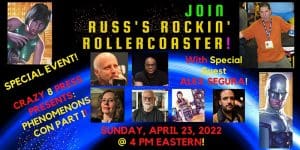
You can watch the first session, featuring Michael Jan Friedman, Russ Colchamiro, Hildy Silverman, Paul Kupperberg, Geoffrey Thorne and special guest Alex segura, here.

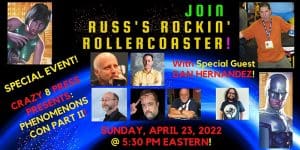
And you can watch the rest of us, Mike, Russ, Peter David, Bob Greenberger, Aaron Rosenberg, Glen Hauman, and special guest Dan Hernandez, chat up our contributions here.

If you also missed the news, there will be a second volume. The Kickstarter campaign for this is coming soon so stay tuned for the announcement.

PHENOMENONS CON! Hear us talk about our new pantheon of superheroes!

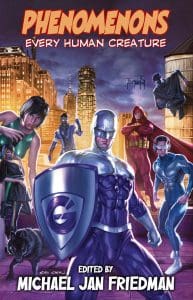
On April 23rd, we’re going to launch a virtual convention–what we hope will become a perennial event–to promote our Phenomenons shared-world anthology series!

There will be two live, one-hour components–one at 4:00 p.m. EST and a second at 5:30 p.m. EST, each one featuring Crazy 8 members who are making big contributions to Phenomenons, as well as a special guest. In the first session, that guest will be Alex Segura, who’s taking the world by storm with his new novel, Secret Identity—and who’ll be contributing to the Phenomenons oeuvre starting with Volume 2! In the second session, our special guest will be Dan Hernandez, co-writer of the Pokémon Detective Pikachu and The Addams Family 2 movies–and a Phenomenons stalwart from the beginning!

Everyone will need to sign up for one session or the other in advance. Afterward, both sessions will be available on YouTube.

“Tickets,” which are free, are available first come first served.
In this first attempt at a virtual con, as there are a lot of moving parts, we fully expect some glitches and maybe even some missed opportunities. Rest assured that we’ll do our best to improve on them going forward.
As always, we’re grateful for your support–and Phenomenons Con is one way we intend to show it.

Attendees will receive a digital C8 eBook sampler.

Please pick hour #1 (special guest Alex Segura)
or hour #2 (special guest Dan Hernandez)

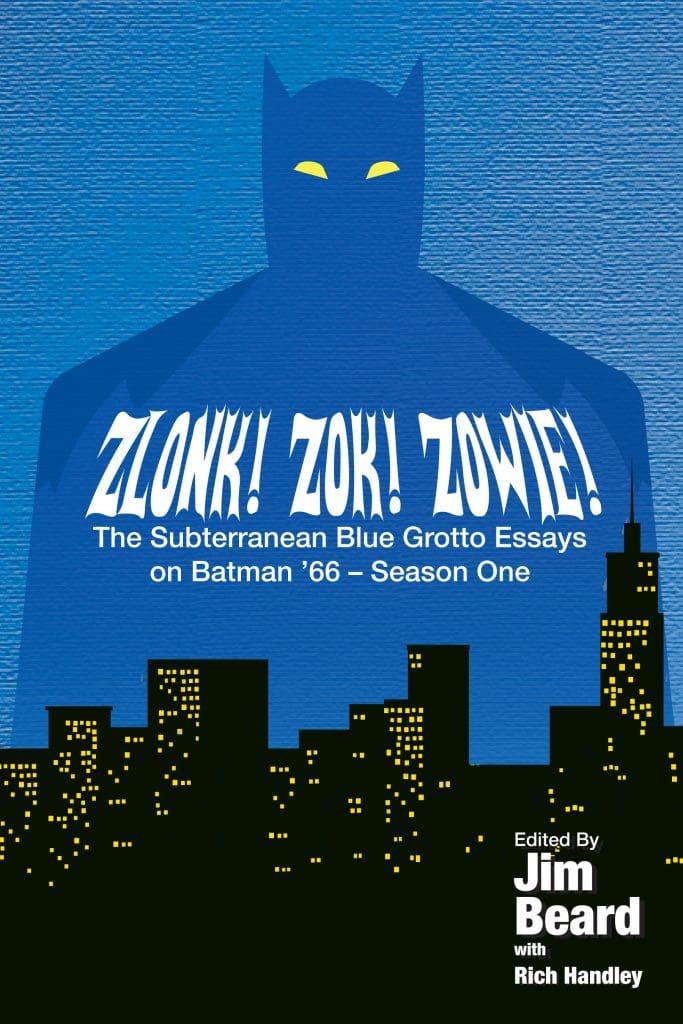
Jim Beard Talks Oooff! Boff! Splatt!

I was eight months old on January 12th, 1966. I didn’t watch the premiere of Batman that chilly evening—we lived in Toledo, Ohio—but somehow, I “saw” it, and it set the course for my life from that moment on.

There’s no doubt in my mind my father had the show on that Wednesday night. He was a Batman fan as a kid, growing up in the 1940s and 1950s, and I can’t imagine him not tuning it in in 1966. There were two other kids in the house then, my older brother and sister, four and five years old respectively, and while they weren’t necessarily devotees of comic books and the like, it’s also hard to imagine kids that age not watching Batman.

Me? I was probably sleeping at 7:30 pm, or at least burping and rolling over. Who knows? Maybe I was in the living room when “Batman IN COLOR” flashed on the screen. I’d like to think I was. How else would I have become such a fan myself of the Caped Crusader?

Well, for one thing, there was a lot of Bat-stuff around the house back when I was growing up. There were a few comics leftover from my father’s childhood, as well as a few then-current “New Look” Bat-books; there were a puzzle, a card game, coloring books, a Switch-N-Go set, and a Magic Magnetic Gotham City, just to name a few things. Add to all that the DNA I inherited and, well, any wonder I am how I am?

My first real memories of the TV show are from the first syndication run (although, technically, I was almost three years old the night it ended, March 14th, 1968), and to my young mind, it was on all the time. I was never left wanting back then; I could turn the TV on at nearly any time of the day or evening and Batman would be there—or so it seemed.

And I loved it. I loved everything about it; the colors, the action, the good guys, and the bad guys. And, like almost everyone who watched it as a kid, I believed it. I distinctly remember the first time I ever heard someone remark about how fake the fights looked, and me, with the superiority of a child, remonstrated them for their lack of vision…in other words, I told ‘em they were blind. What do you mean fake? Those Bat-fights were real, dummy!

As I grew up and the show became harder to see—syndication wasn’t always reliable as television channels grew in number and the foibles of area broadcasts came into play—but that was okay because Batman was always playing in my head anyway. I never forgot anything about it, and when I was able to visit with it from time to time, it was like an old friend at the door, smiling and very, very welcome.

In 1986, I entered into a new phase of my love affair with the show, though I didn’t know it at the time. I worked at a bookstore then, and one day I spotted a new book on the shelves: Joel Eisner’s The Official Batman Batbook. An epiphany? Angels blowing trumpets? Winning the lottery? Yeah, something like that, because it was that day that I started wrapping my brain around the idea of people publishing books about “obscure” TV shows.

You see where this is going?

I wasn’t yet a write then, nor an editor or publisher, but I think that’s when the seeds were planted for my own foray into talking about Batman through the medium of publishing.

After Joel’s book—which I loved and proceeded to read into tatters—there was virtually nothing else on the show. Probably a lot of that has to do with the fact that it took about fifty years for it to be released on home-viewing strata. Plus, it was widely considered a joke, something to be embarrassed about; Frank Miller had a lot to do with that, him with his 1986 The Dark Knight Returns, and then of course there was that big-budget “serious” feature film in 1989. I dug in my heels, firm in my belief that all kinds of Batmans can exist at the same time, but it was still a while before I threw up my hands in frustration and did something about the dreams that were brewing on the backburner in my brain.

In 2010, I created an edited a book called Gotham City 14 Miles. Its subtitle was 14 Essays on Why the 1960s Batman TV Series Matters. When I went around promoting the book, I minced no words in telling everyone I could that it came into existence because, for my money, there just weren’t enough books on the subject. There were, maybe, conservatively, two. How could that be? I set about doing something about the obvious gaffe.

People seemed to like Gotham City 14 Miles, and it felt good to fill the gap I saw in the publishing business. Then, in 2020, I did it again.

I won’t belabor this blog with the Secret Origin of the Subterranean Blue Grotto books—you can find that in my introductions to the tomes, but I did want to say, in a roundabout way, that sometimes people do things because they want something, and that thing just isn’t around to be had. My Batman books exist because they didn’t exist before I brought them into existence. Dreams do happen, but sometimes you have to push them into the waking world.

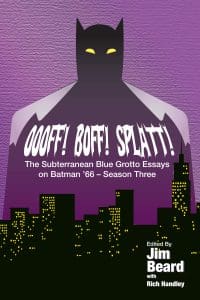
I’ve had a blast doing these books. I am so thrilled to be able to finish the trilogy with the publication of Oooff! Boff! Splatt! I am also equal parts relieved and glad it’s done and done. I hope everyone’s been enjoying them as much as I’ve enjoyed assembling them.

Thanks to everyone who had a hand in them. I couldn’t have done it without you all.

Mel Brooks summed up my feelings about life in the title song of his film, The Twelve Chairs: “Hope for the best, expect the worst.”

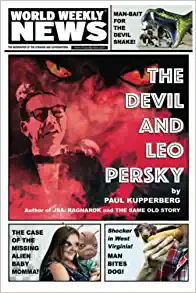
In The Devil and Leo Persky, you’ll meet Leo Persky, the living embodiment of that philosophy. Under the penname “Terrance Strange” (the earlier pseudonym of his grandfather Jacob, himself a monster-hunter and journalist of the weird), Leo is a columnist for World Weekly News, a supermarket tabloid of the supernatural and strange in a world where every Bat Boy, Bigfoot, alien baby, Satan visiting, Elvis sighting story is the truth. A world where vampires exist, magic is real, and extraterrestrial visitations routine.

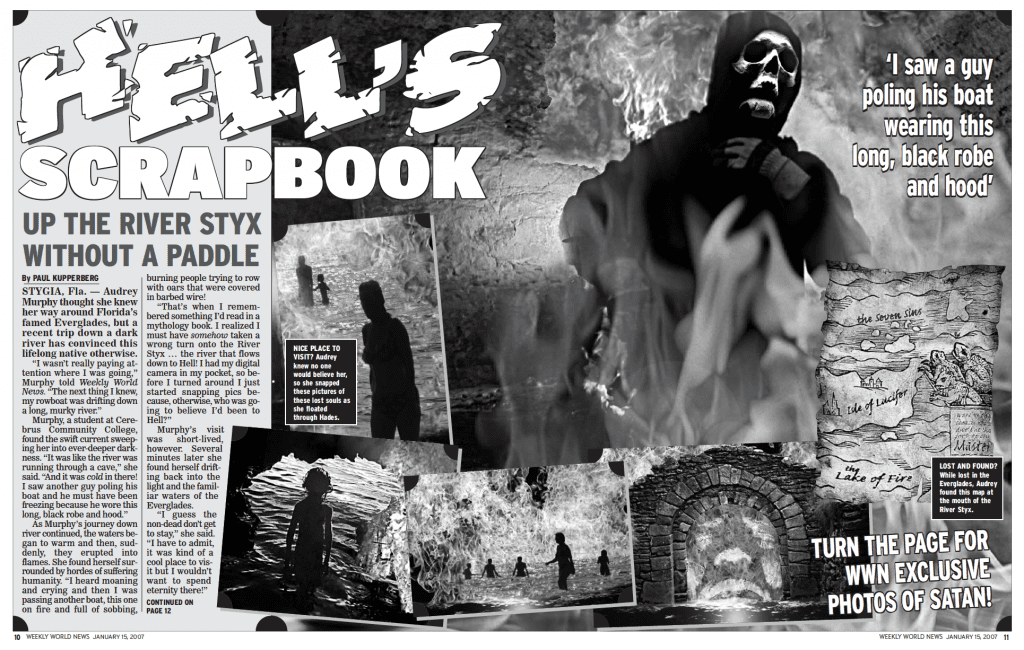
What you may not know about me is, I was once a reporter for Weekly World News (1979 – 2007), the black and white tabloid that billed itself as “the world’s only reliable newspaper.” There was truth in that statement; you could rely on virtually every word in it to be made up, excluding the trivia column and the 6-point type warning at the bottom of page two that virtually every word in it was made up and suggesting readers suspend their belief for the sake of enjoyment. From 2005 to 2007, I wrote close to 100 bylined stories for the paper, as well as ghost writing at least that many more under the names of our numerous fictitious columnists ranging from “Miss Adventure, the Gayest American Hero” to “Ed Anger” to “Lester the Typing Horse” and “Sammy the Chatting Chimp” once I was on staff as Executive Editor from February 2006 to the end in August 2007.

In 2010, I was asked to contribute to an anthology about vampires. At first, my thinking went down the more traditional road of dark, angsty tales of cursed people, but I was having a hard time tapping into the necessary melodrama of the situation. Horror had never really my cup of tea; the tame, old timey black and white horror movies I grew up on from the 1930s to the 1950s weren’t really all that horrifying, and, in fact, looking back at them with modern eyes, are pretty campy and funny. And the modern blood-spurty “don’t go in the basement” kind are all formula and no surprise. Comic book horror stories of the time were equally lame, published under a code that prohibited every single horror trope imaginable. The only time I’ve ever really been frightened by horror was the moment in the 1963 Twilight Zone episode, “Nightmare at 20,000 Feet” when William Shatner lifts the window shade to find the face of the gremlin staring in at him. My brothers and I jumped, screaming as one, and slept with the lights on that night. I was 8 years old.

I did a lot of stories about the supernatural for the News… I even wrote a multi-part tie-in/crossover story with the CW-TV show Supernatural! There wasn’t a serious bone in the body of any one of any of those articles. So when I needed a horror story, I decided to go at it from the angle of a reporter for a tabloid in the aforementioned world where all this stuff was true. And because I’m a wiseass, I made my reporter one too because, you know, it makes writing dialogue that much easier. Write what you know, they say, so I also made him kind of a nebbish. And 5’ 7”.

I had so much fun with Leo in that first story that I returned to him five times for further adventures over the next decade (well, technically four, since one of the stories, another vampire tale, “Come in, Sit Down, Have a Bite,” stars Leo’s mom, Barbara, herself a retired monster-hunter), including in stories for the Crazy 8 anthologies Bad Ass Moms, Love, Murder, Mayhem, and Thrilling Adventure Yarns 2021. Those 6 stories and an all-new 27,000-word novella are now available as The Devil and Leo Persky, all under a sterling cover by my buddy, artist/poet/performer/mensch/designer Rick Stasi. And speaking of old friends, at the made-up World Weekly News, Leo Persky’s editor is Rob Greenberg, a highly fictionalized take on fellow Crazy 8’er Bob Greenberger (not a vampire!), who had been the Weekly World News’ managing editor with me.

I start off writing every story hoping for the best but expecting the worst. Some I have to chase all over the damned place before I finally find the story I had been trying to write from the start, believing without doubt that I’d spend countless days and thousands of wasted words before having to abandon the effort as hopeless. But Leo has never given me a moment’s doubt. I didn’t usually have any more of an idea where a Leo story was headed than I did with those that gave me trouble, but I always knew he would get me there, sooner or later, snarky wisecracks and all.

The Devil and Leo Persky is now available on Amazon in paperback and eBook.

Aaron Rosenberg Talks Time . . . of the Phoenix

Stories change and grow and evolve over time. It’s one of the things that makes oral storytelling in particular so vibrant, that the core of the story may remain the same but the details and even the style and flow can change to reflect current attitudes and issues.

Prose fiction doesn’t adjust in the same way, of course. After all, once you write it down and especially once you publish it, it’s a fixed form. Unless you plan to emulate Walt Whitman, who continually updated and revised Leaves of Grass, that book is now set, as is the story within it.

But when you’re working on a series, there’s still room to play, to revise, to change course. Sometimes it’s because you realized something partway through, and other times because the world around you has changed—or you have—and you discover that the story you started out to tell isn’t the one you want to tell now.

When Steven Savile and I started Time of the Phoenix, back in 2009, we already knew that it would be a series following the immortal Phoenix, avatar of humanity’s creativity, throughout history. We bounced around ideas about various historical figures, came up with a rough timeline showing who the Phoenix had become and when, and then sketched out a set of five stories from that. We released the first one, “For This Is Hell,” in 2011. We were both happy with that first story, and it did well.

Time passed. Every so often I’d bring up the idea of returning to the Phoenix, but something always came up, some other project that needed to get done first—sometimes Steve’s, sometimes mine. More often it was his, and as the years piled on I started to feel that I might just have to continue the tale on my own. Steve was fine with that—relieved, even, because he felt bad about being the one more often delaying the project—and so with his blessing I sat down and wrote the second tale, “One Haunted Summer.” That came out in 2019.

I was happy with this one, too, and decided I’d continue the project by releasing one a year, each time in October, which happens to be my birth month. When better for a story that’s dark fantasy verging on horror?

But a funny thing happened when I went back to our notes about the rest of the story. I discovered I didn’t like them. I wasn’t happy with the projected next book. The one after that was still good, though it would need some twisting about—I still liked the basic premise, but with two already done I decided this one needed to be re-aligned to better match them. The final book, however, I absolutely hated. There were several reasons for that, some deeply rooted in what had gone on in this country during that intervening time, but others in the differences between Steven and myself. He’s much more of a horror writer than I am, and perfectly happy writing dark and depressing. I tend more toward the upbeat, with at least glimmers of hope. And with him no longer on the project, I wasn’t interested in having the tone get progressively darker, as we’d originally planned.

I noticed something else about the first two stories and the projected fourth one, too—each of them dealt with a different form of creativity involving words and writing. “For This Is Hell” was clearly centered on playwriting, while “One Haunted Summer” focused on prose and the fourth, “Death in Silents,” was all about the silent film industry. But the original third and fifth books had nothing to do with writing, or creativity, really. That just didn’t fit. It didn’t fit where I’d taken the story, and it didn’t fit the concept of the Phoenix in general.

So I ditched them both. After all, these were just initial notes, and I wasn’t beholden to anyone to stick to them. Instead I moved “Death in Silents” forward to Book Three, and figured out a new book four dealing with music and songwriting. I also came up with a way to close out the larger tale in that fourth book, removing the need for a fifth altogether.

I also went back and rebuilt the covers for Books One and Two. A friend of Steven’s, a really great illustrator named Vance Kelly, had graciously given us the image for “For This Is Hell,” but while striking I realized it didn’t say anything about the genre featured in that book. And the cover image I’d created for “One Haunted Summer” referred to the story location but also not to its genre, whereas the image for “Death in Silents” was a clear nod to silent film. Redoing those first two covers tied them more clearly into the series—I built the cover for the fourth book, “Cross the Road,” to emulate the dust jacket of a blues record from that era—and I then used each story’s cover as its frontispiece in the collected print edition, Time of the Phoenix.

I’m happy with how it’s all turned out. And I don’t view the original plan as a mistake, just as an initial draft on the idea. This tale has been a process—a long one, at times—and I’ve grown and evolved along the way. It makes sense, then, that the story would as well.