
All posts by Bob Greenberger

Authors Respond to Reader’s Question

Rachel Thompson has been reading our columns about science fiction and asked an interesting question.

“I write sci-fi and fantasy and I’m learning the market for it is as tight as a buzzard’s ass in a power dive. Its seems to me zombies have taken over the ideas and market that sci-fi once dominated. I still love old fashion sci-fi as you do but it’s getting very hard to find sci-fi in book stores and even harder to get mine published. I do Kurt Vonnegut- like social satire along with outer forms: will sci-fi ever make a popularity come-back or I’m I just pissing down a gravity well?”

I put it to our collective for responses and here’s what some of us have had to say:

Aaron Rosenberg:

The thing about SF is that it’s actually more popular than ever. Just not in print. It’s appearing more and more in mainstream movies and even TV shows (Pacific Rim and Almost Human, anyone?), and people are loving it, including people who before this would never have read an SF novel in a million years. My hope is that at least some of those new fans will realize there are–gasp!–BOOKS with the same ideas and topics they’re now enjoying onscreen, and will then become new SF readers as well. In the meantime, SF fiction continues to have a hardcore fan base which I don’t think will ever go away. Market share is certainly tough right now, though, because publishers, especially the big houses, only want The Next Big Thing–they don’t do a lot of mid-list anymore, so they’re not interested in books that would still have solid sales numbers but might not crack the bestseller lists. Fortunately, there are tons of small presses out there now picking up the slack. People just like us. :) So don’t give up hope, and make sure to explore all your options–shoot for a big publisher first because if they pick you up they can do more marketing and publicity and distribution than you’d get otherwise, but don’t  ignore or discount a small press that can still do a nice job on your book and will work a lot harder for you because they form a more personal connection with each of their authors.

Paul Kupperberg:

The market is tight all over. The genre markets may have been hit hardest, and, yes, science fiction has been supplanted in the marketplace by zombies. In mysteries, I think the market usurper is the mainstream thriller. And the Sherlock Holmes pastiche. (And cats.) I believe the more eReaders there are in peoples’ pockets and purses, the more the tendency is going to be to lean towards “lite” versions of the popular genres because they’re going to be reading them in more frequent but shorter bursts; whenever there’s a spare moment, whip out the Kindle and read a few paragraphs before it’s your turn at the ATM. In the olden, pre-corporate days of publishing, untried writers stood a greater chance of being published because there were more slots to fill on the newsstand racks and bookstore shelves. Now, with distribution so tight and expensive, publishers have adopted the Hollywood-model–put everything you’ve got into the next summer blockbuster and leave the low-budget fare that needs the P.R. push to fend for itself. Which is likely to lead it to online publishing…but I wonder how many buyers browse Amazon.com or Barnesandnoble.com the way they browse bookstore shelves, looking for something that will catch their interest, rather than logging on to buy a specific book or author they’ve just heard about. So small publishers are the future.

So small publishers are the future. The SF marketplace may seem a bit slow now, but as readers increasingly buy books online, the e-reader marketplace for SF will continue to expand.

And often, as it does, the quality books will rise to the top and connect with an audience hungry for those kinds of stories.

Robert Greenberger:

This weekend’s Washington Post listed their top 50 novels of 2013 and Stephen King’s sequel to The Shining is the only genre book to make the list. This does not mean that science fiction, fantasy, and horror are no longer being read, but they never get the same serious analysis, review, and exposure as mainstream fiction. It has usually been this way. While Mysteries seem to get a lot of coverage, thanks to the best selling status of so many authors, every other genre usually gets short shrift. It seems that the very idea of writing in a genre from Westerns to Military appear to be looked down upon despite how much of out mainstream media output is entirely made up of genre material. Apparently, reading is reserved for more highfalutin fare.

And yet, so many of us are writing science fiction, fantasy, and horror fiction, just appealing to a smaller, more dedicated audience. Small presses such as Crazy 8 Press let people find the fiction they like and in many ways, there is more available to readers thanks to digital publishing. The mainstream houses continue to also pump out these genres with new imprints announced with encouraging regularity.
The Play’s The Thing

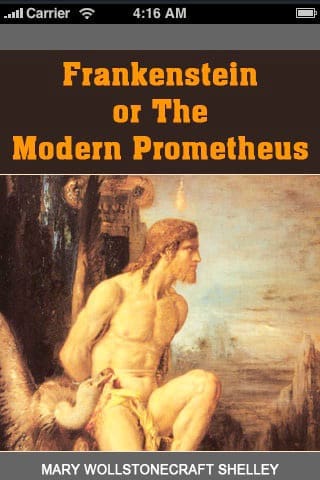
frankenstein-or-the-modern-prometheus-by-mary-wollstonecraft-shelley-screenshot-1When did science fiction begin? It’s an interesting question. And as we decide where we’re going as practitioners of the genre, maybe we should think about where we came from.

Many a hardcore fan will tell you that the backbone of science fiction is the written narrative. After all, Hugo Gernsback, generally acknowledged as the father of the genre–though he preferred the term “scientifiction” to “science fiction”–published magazines made up of short stories.

And if we go a little further back, there are the pulps, and before that Herbert George Wells and Jules Verne, and even further back Mary Shelley’s dark and disturbing cautionary tale, a little piece she subtitled The Modern Prometheus. Should we consider Gulliver’s Travels a piece of science fiction? How about Sir Francis Bacon’s New Atlantis, written a few short years after the English started their colony in Jamestown? We can argue until the cows come home (where were they, anyway, and what were they up to? Something to do with bovine-human hybridization?) about which of these works got the ball rolling, but one observation is inescapable: They were all written narratives.

Me, I’d argue that the first example of science fiction wasn’t any of these estimable artifices, and that it wasn’t a written narrative either. Ladies and gentlemen, exhibit A: The Birds.

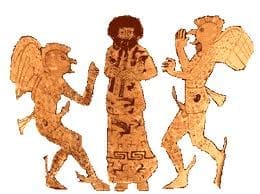
The BirdsNot the Hitchcock movie, though that certainly has its place in science fiction lore as well. This is the comedy by Aristophanes, first performed at a festival in Dionysia in 414 B.C. (or so I’ve heard; I wasn’t present at the time, contrary to what some of you may be wondering). The Birds is about two Athenian citizens, Pisthetaerus and Euelpidies, who encourage the birds of the world to built an ideal society, which the Athenians call Cloudcuckooland. Groundbound humans are so impressed with the place that they forget to sacrifice to the Olympian gods, who visit Cloudcuckooland to protest. SPOILER ALERT: The Olympians fail and the bird society prevails.

The word “utopia” wouldn’t exist for a couple of millennia, but that’s exactly what Cloudcuckooland was. It asked the essential “What if?” question–in this case, “What if we built a society from scratch?” And that’s what made it science fiction, as much so as Asimov’s Foundation or Blish’s Cities in Flight.

George Clooney as Pisthetaerus? Anthony Hopkins as Zeus (not such a stretch now that he’s played Odin)? John Malkovich as Prometheus, who tries to hide himself under a parasol at one point in the play? Okay, not likely. But The Birds unequivocally holds a historical place on the science fiction mantelpiece. And if you’re Aristophanes, that’s something (wait for it) worth crowing about.

Examining Science Fiction Across the Genres

Asimov's MysteriesWhen I was six years old I met my first alien. He hailed from a planet called Krypton but looked like you and me. Growing up, every fall meant I would come down with bronchitis and wind up in bed for a while. That pivotal year, I was given an issue of Superman and was hooked. A few years later, my fascination with the four-color hero expanded to all manner of super-heroes which was a short leap to television, movies, and finally, prose.

I still recall being at Mid-Island Plaza with my dad, going into the Cherry Hill Bookstore and have him take me to the science fiction section. He scanned the shelves and plucked a copy of Asimov’s Mysteries for reasons lost to time. It was my first adult science fiction book – and I still have it.

So, for the last 50 years or so, I’ve been engrossed with all manner of science fiction. That means I’ve consumed a tremendous amount of fare. Truth be told, nowhere near enough of the classic or modern day prose, but I remain a fan. It also means it takes a lot to enthrall me and a lot less to annoy me.

There were moments of sheet bliss such as the first time I watched Star Wars in a theater, feeling like a kid once more. George Lucas successfully nailed the gosh wow feel of the old movie serials I grew up watching in reruns on weekend television.

tumblr_lsb43pdld41qgxy6bo1_500I still recall the excitement my college friends and I felt when Battlestar Galactica was going to debut on a Sunday evening. We all gathered at Ricky’s off-campus house and had dinner, settling onto the couch to watch. We were uniformly appalled at how shoddy it felt with a tired script and weak actor (Lorne Greene notwithstanding). Thankfully the suck was interrupted by the news that Carter brokered a deal with Israel and Egypt. A short while later, I was even angrier at the travesty that was NBC’s updating of Buck Rogers, ignoring the source material.

Successful science fiction in the comics was easily done as witnessed by EC’s wonderful works, which I discovered in paperback form in the 1970s. Mike Friedrich’s Star*Reach also showed how it was done during that same decade so I kept wondering why television kept getting it wrong (a decade later they began figuring it out).

I have a stack of science fiction books on my TBR shelf, some dating back a decade or more, some from last year. Ask me the last great one I read, the title that immediately pops up is Connie Willis’ The Domesday Book, which I read only a year or two back. There’s still a sense of wonder in a tale well told. Being invited into someone else’s imagination is a nice vacation from my reality and I marvel at where their ideas come from.

May I never lose that interest in what comes next.

I am the Salamander Kickstarter Campaign in Full Swing

After four days, Michael Jan Friedman’s Kickstarter campaign for his new novel, I Am The Salamander, is right on pace to meet its goal of $5,000 by November 16th–and he’s got a team of 27 backers to thank.

“I can’t tell you grateful I am to these wonderful people for meeting the challenge I laid out for them,” Mike said, “and there are many more who have helped to spread the word, for which I’m grateful as well.”

I Am The Salamander is the story of a teen-aged superhero. But it’s not just his strange powers that set him apart from the crowd. It’s the fact that he’s a cancer survivor–a creative risk that Mike has decided to undertake.

“People don’t like to talk about cancer,” he said. “They don’t like it in their fantasy books. It’s too real. But it’s among us. And hope is such a big part of the formula for surviving cancer. If I Am The Salamander can offer even one young person the strength to plug on against the odds…that’s a goal worth the risk, isn’t it?

“One of my backers has a child who survived cancer. That’s about the most beautiful thing I can think of. It inspires me to make I Am The Salamander the best book it’s in my power to write.”

Mike Friedman Kickstarts his Newest Novel

SALAMANDER_COVERLONG ISLAND, NY (October 17, 2013) — The hero of veteran science fiction writer Michael Jan Friedman’s new young-adult superhero novel, I Am The Salamander,  is a cancer survivor.

“I didn’t set out to make Tim Cruz a kid who had cancer,” Friedman said. “But when you read I Am The Salamander, you’ll see why it makes perfect sense for Tim to have beaten that disease, and why he’s in a position to offer hope to real teens trying to beat cancer themselves. And let’s face it, hope is what superheroes do best.”

I Am The Salamander is being funded by a Kickstarter campaign. ““The publishing landscape has changed,” said Friedman, who has written 70 novels for major publishers like Simon & Schuster, Harper Collins, and Random House. “It’s harder than ever to get publishers to take a chance on a story, especially a quirky one like I Am The Salamander. And when they do, the book’s shelf life is shorter than that of a jar of half-sour pickles.

“I want I Am The Salamander to be around for a good long time,” he said. “That means I have to get it in the hands of readers on my own, and I have to keep it available to them.”

However, Friedman said, he wouldn’t ask anyone to donate to the I Am The Salamander campaign “just because it’s a worthwhile thing to do. I’m asking because it’s also the best thing I’ve ever written, and because I want to get it out to readers the most direct way possible.”

Friedman is asking his readers for $5,000. to cover the cost of book design and printing. The book’s cover was rendered by up-and-coming Brazilian talent Caio Cacau, who previously illustrated the cover to Friedman’s recently rereleased first novel, The Hammer and the Horn.

Those who wish to make donations to the I Am The Salamander campaign can do so at Kickstarter.com.

What One Piece of Writing Inspires Us?

I hate being asked about a favorite writer or book because it is like singling out a favorite child or family member. I like many different writers, many different books and have been an omnivorous reader for so long that I love certain books but prefer reading other, new works rather than circle back and keep re-reading the same ones.

Also, as I have grown up and have called upon all my reading to perform various tasks, from writing fiction to teaching in the classroom, different authors and works come to mind. I envy those who can conjure up beloved passages of fiction and poetry, especially their own works. My mind just doesn’t work that way.

So, this month, as the Crazy 8 Press writers discuss the one piece of writing that most inspires us, I am drawing a blank. The answer really is: it depends. Much as I put on different music for different tasks, different works come to mind.

For example, when I’m feeling really stuck, I read West Wing scripts by Aaron Sorkin to look at not only structure but how dialogue can reveal character. In a lot of my later Star Trek fiction, I found those works particularly useful.

Now that I am in the classroom, I realize different works about the writing and reading process, such as Stephen King’s On Writing come to mind and can be used with greater effectiveness than pure academic texts on the subject. Heck, whenever I get a chance to teach a creative writing course that may be the one book they read cover to cover. Beyond that, I’ve worked my way through various texts on the writing process such as Donald Maas’ Writing the Breakout Novel or Peter David’s Writing for Comics.

Other times, I study how certain prime time shows are structured. I’ve made little secret that I think Shonda Rhimes’ structure on Grey’s Anatomy is pretty strong and it’s testament to the foundation that it’s endured for a decade.  I’m studying shorter run series, such as House of Cards to see how to gain stronger impact when you’re limited in duration.

I’ve recently read the eighth and nine novels in Jim Butcher’s wonder Dresden Files series and have admired how he continues to advance the meta story while putting his protagonist through the wringer and that despite surviving each escapade, still doesn’t realize how powerful and successful he has been. All he sees are the flaws which in its own way is a strength and something I can learn from.

So really, it depends upon time and circumstance but the sheer breadth and depth of the writing I’ve exposed myself to really has made me a better reader and, hopefully, a stronger writer.