Our new Crazy 8 Press anthology — Love, Murder & Mayhem — came about for purely selfish reasons. And her name is Angela Hardwicke, but I’ll come back to that.
It was my turn among us Crazy 8 Press authors to run the new anthology. My theme was that each story (there are 15 total) had to include at least one act of love or romance, at least one murder, and mayhem welcome … with every story set within a science fiction setting.
I also opened up the doors (as we have been doing) to outside author friends of ours, and I insisted that the lineup include about an equal mix of male and female writers.
The stories are all one-shots … so there are no interlocking characters or inter-connected narratives. Each author delivered his or her own story, in their own distinct Universes.
But why this theme?
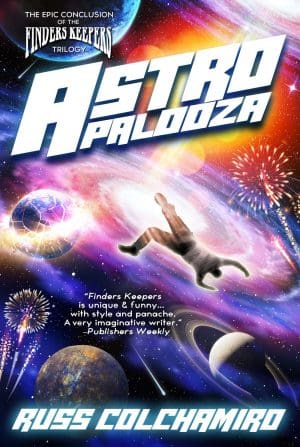
For the uninitiated … among works of fiction, I am the author of the three-book scifi backpacking comedy series that includes FINDERS KEEPERS, GENIUS DE MILO, and ASTROPALOOZA (the final book in the series, which launched earlier this year).
In the second book, GENIUS DE MILO, I introduced a new character, although just as a cameo. Her name? You guessed it. Angela Hardwicke.
She’s a private eye, envisioned in that classic Sam Spade style — trench coat, fedora, and all, the kind of character I’ve always wanted to write.
I upgraded Hardwicke in the series finale, ASTROPALOOZA, where she plays a fairly prominent role. But I knew early on that I eventually wanted to give her a stand-alone series, where she becomes the central figure. The star.
Going forward my plan is to give her at least three books of her own, which will include her origin story, at least one key nemesis, and a long and tortured journey which helps drive her underlying motivations.
But before I dive into an entire series, I wanted to do a test case with Hardwicke. So I figured, what better way than through a short story, with her in the lead, as a way for me to get a better sense of who she is, how she operates, and what the future holds for her.
Thus, my tale in this anthology is entitled: The Hardwicke Files: The Case of My Old New Life and the One I Never Knew. The narrative has Hardwicke investigating a mysterious fire at a music club in E-Town (the realm where the Universe is created), where a body turns up dead, and with a tangential connection to Hardwicke herself.
Another confession — when I set this anthology in motion, in my mind’s eye I thought I’d get nothing but detective stories. And I did get a few others. But I also got stories with superheroes and supervillains. Stories set off-world and in space cruisers. Plus artificial intelligence, a monster mash and (for good measure) … one DuckBob!
Did I have my own motivations to set this anthology in motion? You bet.
But like any great mystery, this collection of love, murder, and mayhem stories had me starting off in one place, taking me across the Universe and back, and ending up in a way—and in places—I never saw coming.
I wouldn’t have it any other way.
Enjoy!
Russ
Love, Murder & Mayhem from Crazy 8 Press will be on sale both in print and digital formats in July. Stay tuned for updates!
Russ Colchamiro is the author of the rollicking space adventure, Crossline, the hilarious sci-fi backpacking comedy series, Finders Keepers, Genius de Milo, and Astropalooza, and is editor of the new anthology, Love, Murder & Mayhem. He is a member of Crazy 8 Press.
Russ lives in New Jersey with his wife, two children, and crazy dog, Simon, who may in fact be an alien himself. Russ has also contributed to several other anthologies, including Tales of the Crimson Keep, Pangaea, Altered States of the Union, and TV Gods 2. He is now at work on a top-secret project, and a Finders Keepers spin-off.
For more on Astropalooza and Russ’ other tales, you can visit www.russcolchamiro.com, follow him on Twitter @AuthorDudeRuss, and ‘like’ his Facebook author page.
Cabal and Other Irresponsible Invocations of The Muse is my first book of short fiction. It’s got all the kinds of stories I’ve become known for in books, in comics, and on TV–fantasy, science fiction, and super-hero tales.
It’s funny…until recently, I never felt compelled to write short stories. My natural inclination has always been to write full-length novels. If somebody was editing an anthology and they invited me to contribute, sure, I did that, and I invariably enjoyed it. But left to my own devices, I instinctively turned everything into an epic.
Then, about a year ago, I was kicking around a story called Cabal. We’ve all seen comic book heroes fighting teams of villains bent on taking them down for nefarious purposes, right? Well, in Cabal, I wanted to turn that notion on its ear. I wanted the team trying to take down the super-powered character to have only the best intentions. Then, as the story unfolded, we would find out if they were right or wrong to have those intentions.
And it would be a novel, of course. Because that’s what I’d always written. But Cabal didn’t want to be a novel. It wanted to be something shorter than that. I was flummoxed–flummoxed, I tell ya. But like any experienced writer, I knew better than to argue with my story. And that was how Cabal became a novella.
So great, I had a novella on my hands. Unfortunately, the market for novellas is a tricky one. I could have just made an e-book out of Cabal but, you know, I like the idea of holding a book in my hands. And it just so happened that I had other story ideas that I’d been kicking around, and the more I thought about them the more I realized they didn’t want to be novels either.
Eventually, I gave in. Short stories they yearned to be and short stories they would become. Which, in the end, turned out just fine…because I really like the work I’m doing in these stories. I’m proud of it. From top to bottom, these tales are as good as any novel I’ve ever written. (Better, maybe.)
But don’t take it from me. You be the judge. After all, you’re the one I’m writing for.
So, besides Cabal…what’s in this book?
* In The Speaker of Verse, a prequel to my Aztlan series of 21st-century Aztec Empire murder mysteries, a young Maxtla Colhua investigates the murder of a highly regarded educator.
* In The Scales of Justice, an untested advocate tries to right an old wrong in The City of A Thousand Gods.
* In Headless, a crewman aboard a starship does his best to persevere without a critical portion of his anatomy.
* In Behind Every Great Enhanced Being, the mothers of teenaged interplanetary heroes clash as only mothers can.
* In Connections, a woman with remarkable intellectual powers finally appears to have met her match.
* In The Wall…yeah, that Wall…we scale a possible future in a reality you just might recognize.
My Kickstarter campaign began last night and I am hopeful you will give it a look, like what you see, and support it.
There’s a tendency among us humans to exaggerate. Just a wee bit.
Things like … I’ve been doing this half my life!
Yet in my case … in this particular case … it happens to be true.
ASTROPALOOZA is not just my newest novel. It’s also the third and final entry in my SciFi backpacking comedy series, which started with FINDERS KEEPERS, continued with GENIUS DE MILO, and now concludes with ASTROPALOOZA.
I have to say … whew! What a journey it’s been.
For the uninitiated … FINDERS KEEPERS is loosely based on a series of backpacking trips I personally took through Europe and New Zealand, set against a jar that contains the Universe’s DNA.
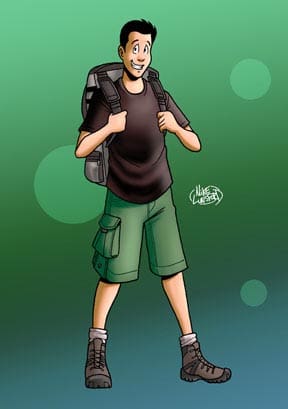
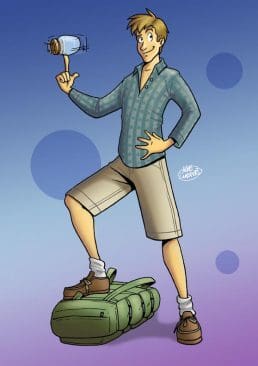
When we first start our gonzo tale … bumbling backpackers Jason Medley (from New York) and Theo Barnes (from Auckland, New Zealand) meet in Europe and become fast friends. Their biggest worries include … can I get the hot girl? Can I make my train to Amsterdam? I’m hung over … again.
Meanwhile, as they fret over their ability to pay off student loans and eventually become full-fledged adults … the galaxy is about to be wiped out of existence as a motley crew — from Earth and a galactic realm — chase down that missing jar of the Universe’s DNA, because they all think the boys have it.
Our heroes are at the center of the action only … they don’t know it. So as the reader you’re in on the joke … and they’re not.
Throughout FINDERS KEEPERS, GENIUS DE MILO, and now ASTROPALOOZA, the boys somehow stumble their way into saving the Universe, only … every ass backwards solution they come up with sets in motion an even bigger, more complicated problem.
And so it goes, raising the stakes with each new adventure.
In ASTROPALOOZA, there are two massive energy waves barreling towards one another, and if they collide in space before the boys save the day one last time, the waves’ll smash together, initiating the next Big Bang, wiping out Existence as we know it.
Which brings me back to the beginning.
I took my first backpacking trip to Europe back in 1994. This was at a time in the world where, if you were stranded in the middle of Romania in the dead of night with a crazed, drunken madman on the loose with armed soldiers about to knock on the door — which in fact happened to me — you couldn’t Google where to go next because … there was no Google. There was no Internet.
You had to rely on guide books, whatever knowledge you could pick up, people you met along the way … and your ability to adjust on the fly.
Since then I’ve been around the world and back, including New Zealand, which motivated a lot of the action in these three books.
I’m almost 46 now. Yet I’ve been living, thinking, and writing about these guys and their adventures for the past 23 years.
Half my life.
It’s a symphony of emotions to have spent so much time and effort with Jason, Theo, and the gang, to finally see their journey come to an end. Well … this journey, anyway.
ASTROPALOOLZA is the culmination of it all.
And now that I’m here, I can say this: the boys did right by me.
I hope you have just as much fun with them as I did.
Enjoy the ride.
ASTROPALOOLZA is available for sale in paperback and e-book.
The cake from my going away party at DC Comics when I left to join WWN.
A bunch of years ago, my friend Joe Gentile of Moonstone Books asked me to contribute a short story to an anthology called Vampires: Dracula and the Undead Legions. Out of that came a story called “Man Bites Dog,” starring Weekly World News reporter Leo Persky, better known to his readers as “Terrance Strange.” (“My real name is Leo Persky. But ‘Terrance Strange’ sounds like he’d be a big, strapping adventurer who travels the world seeking out the dangerous and, yes, the strange, while Leo Persky sounds like a middle aged, five foot, seven inch tall balding and bespectacled Jew who cowers at the slightest sign of danger. Seeing as how I am the latter but would rather readers believe I’m the former, I go with the macho name, not to mention a photograph at the top of my column of my paternal grandfather, Jacob Persky, who also used the nom de bizarre of “Strange” but who actually was a big, strapping adventurer who traveled the world seeking out the dangerous. Unfortunately, I take after my mother’s side of the family. Scrawny and whiney.”)
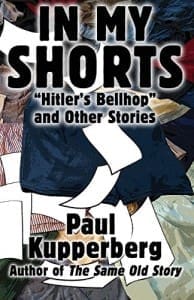
Weekly World News was a real publication–I was Executive Editor for its last year and a half of existence, along with Managing Editor, pal, and Crazy 8 colleague Bob Greenberger–even if everything we published was false. It was a great gig, and I thought it would be fun to write a character who inhabited a world in which WWN was a journal of truth, although a majority of its readers still believed it was all fake. I was right. It was fun. Here’s an excerpt from the third Leo story, “Shunning the Frumious Bandersnatch,” which you can read in its entirety, along with the other Leo stories, if you’re interested, in my Crazy 8 Press short story collection, In My Shorts: Hitler’s Bellhop and Other Stories.
My mirror misery began with Rob Berger, as is true of most of the woes life has chosen to inflict on me. Berger, the size of a grizzly bear, almost as furry, and about twice as ferocious, was the night editor of the News. It was a position for which he was uniquely suited insofar as it kept him separated from the vast majority of the staff who worked the day shift and who speculated that exposure to sunlight would cause him to disintegrate into a heap of dust. He was, to put it kindly, not exactly a people person.
In fact, I have some question as to whether he’s any kind of person at all, but as I rely upon him for my livelihood I was content to give him the benefit of the doubt. For all his flaws ⎯ and they were legion ⎯ he was a hell of an editor. Sure, he motivated through the twin tactics of fear and intimidation, but he knew how to cut to the heart of a story…as well as how to cut the heart out of a reporter who didn’t deliver on an assignment. The fact that I had survived under his despotic reign longer than any other reporter, since my humble beginnings as a wide-eyed and bushy tailed stringer while still in college, I considered myself one of his favorites. Which just meant that he was happy to allow me to continue to draw breath, as long as I was in some form of constant pain and/or discomfort. If by some fluke convergence of karma and good luck I happened not to be in either state, Berger could always be counted on to throw something my way to send me plunging back into the fiery pits of misery.
“So, what do you know about mirrors?” my esteemed editor growled even as my foot crossed the threshold into his den.
“That they’ve yet to make one that won’t crack under your beatific scowl?” I said, hazarding a guess and risking a large, heavy object being hurled at my skull.
He must have been in a benevolent mood because all he did was curse me and several generations of my ancestors for a general lack of intelligence and dubious paternity before saying, “Don’t you read your own goddamned newspaper? I mean the Mirror of the Third City, you moron.”
I swept to the floor the stack of books, manuscripts, and old editions piled on his single visitors chair that he kept there to discourage anyone from sitting down and staying any longer than was necessary.
“Uh-uh, and I’m supposed to know what you mean because I became a mind-reader exactly when?”
“Around the time I emailed the background material to the smart phone this company pays a fortune to supply you with and which you’re supposed to have always switched on and check regularly for such items as emailed background material on things like the Mirror of the Third City, that’s when.”
I sat down.
“Oh. That Mirror of the Third City.”
He did what he did best and glowered at me.
“Who the hell said you could sit down?”
“May I?”
“Yeah. Have a seat. And answer my question.”
“Uh, you see, the phone fell in the toilet and…”
“Not that question, schmuck. The mirror.”
“Legendary ancient Atlantean artifact from the reign of Turmerac the Elder, made with sand from the shores of the Eternal Sea and silver smelted from the soul of his mother-in-law, Calthandra, who he had cast into the fire pits of Darkworld as punishment for conspiring with his son, Turmerac the Younger, to overthrow him in league with, what’s his name? The one-eyed king of the Gem City?”
“Rubic the Obese.”
“Yeah, that’s the one. Papa Turmerac had his royal sorcerer whip up the mirror to entrap sonny’s soul in eternal torment on the razor-edge between this world and Darkworld because, I guess, even he wasn’t cruel enough to have thought of sending the kid to work for you.”
Berger elevated his left eyebrow a quarter of an inch, his version of a sardonic laugh. The only thing that elicited true laughter from him was human misery. Preferably mine.
“I would’ve taught the little bastard the meaning of loyalty, that’s for sure.”
“No doubt. Hell, that’s why you won’t ever catch me conspiring with any one-eyed fat guys against you.”
“Good call. Make sure you keep it that way.”
“So why the sudden interest in a mirror that no one’s seen since about 12,000 B.C. anyway?”
“Because, if you’d read my email, you’d know that it’s turned up again.”
That got my attention.
“No shit? Where?”
“On an episode of ‘The Antique Bazaar,’ shot in Lubbock, Texas. The idiot appraiser lied and told the owner it was a nineteenth century Art Nouveau design, worth maybe a few hundred bucks, and then tried to buy it from the guy after the taping.”
“Uh-oh.”
“Uh-oh is right. The precious stones set into the frame are worth a few million alone, but the mirror itself is priceless…and deadly to anyone whose lies and deceit are reflected in its surface.”
“So the appraiser’s now sharing bunk space in hell with Turmerac, Junior?”
“Yeah, although you’ve got to admit, that’s a fitting punishment for anybody from a reality TV show.”
I couldn’t argue with that, but, as appealing as was the image of Honeybooboo and her clan and all their Jersey shore, motorcycle building, gold mining, storage unit buying ilk writhing on the devil’s pitchfork, I let it go in favor of journalistic inquiry.
“Okay, and then what happened?”
“Then a dwarf warrior with a sword stepped out of the mirror, cut off the lying antique dealer’s head, fought off a couple of freaked out security guards, then took off into the night with the mirror.”
“Gee, you’d think something like that would’ve warranted at least a mention in the local news.”
“It did. Only the authorities told a slightly altered version that fits better with accepted reality and local sensibilities. They blame the attack on a meth crazed illegal Mexican immigrant wielding a fireplace poker that he grabbed from a set brought in for appraisal by a gay couple from Amarillo.”
“Suus ‘facillimus ut sit credere quod suus’ facillimus ut credere,” I said with a shrug of rabbinical proportion.
Rob didn’t miss a beat. “It’s easiest to believe what’s easiest to believe,” he translated, then fixed me with a stare. “Two Jews who know Latin, go figure. Your mission, Persky, like I give a crap whether you decide to accept it or not…”
“Find the mirror,” I said, jumping in on the obvious cue.
“And make it quick, will you?”
“What’s the rush? You’ve got five days until the next issue closes.” I had taken out my smart phone and turned it on so I could get at my email. I’m not as such user friendly in that I’m not a friendly user. I don’t trust technology. Technology is just what we call the magic and alchemy of our age. Instead of witches and bubbling cauldrons, we now have scientists, engineers, and manufacturing to turn our thoughts and desires into something real for personal or political gain. And the magic, no matter what you called it throughout history was, though often triumphant, always corrupted. The Atlanteans called theirs “manna.”
“The rush is, numbskull, people are dying!”
In My Shorts: Hitler’s Bellhop and Other Stories is available:
By which I mean, crass commercialism and holiday insanity (pagan cup of Christmas-hating Starbucks Christmas Blend coffee anyone?) are in full bloom, making life, shopping, and social media things to be, if not feared, at least avoided.
And, seeing as I’m at a point in my life where I’ve been trying to divest myself of the endless cartons of stuff I’ve accumulated and have been schlepping around with me for almost fifty years, the thought that this time of year could bring new stuff to replace it is sort of disturbing. (My need to shed that useless tonnage of paper et al found voice, albeit in the extreme, in a short story “Unburdened,” found here.)
But never let it be said I was a holiday…I’m sorry, Christmas (‘cause I don’t want to be accused of waging a war against Christmas in this, a nation that’s about 85% Christian) buzzkill, and, c’mon, seriously, who doesn’t like getting presents? Especially books.
I love a mystery, especially the classics of the genre. I can’t recommend highly enough any or all of the works of James M. Cain, author of such classics as The Postman Always Rings Twice, Double Indemnity, and Mildred Pierce (although the last, a fine novel in its own right, was turned into a murder mystery by the studio when it was filmed in 1945 starring Joan Crawford). A great introduction to this masterful writer can be had for about $20.00, The Postman Always Rings Twice, Double Indemnity, Mildred Pierce, and Selected Stories (Everyman’s Library Classic, 2003).
When it comes to the comic book side of me, there’s a veritable stack of tomes that I’d like to unwrap on any one of the eight days of Chanukah. Most recently published as I write this is my old friend Paul Levitz’s Will Eisner: Champion of the Graphic Novel, a biography that focuses on The Spirit creator’s contributions to the birth and popularity of the graphic novel form and his impact on creators like Jules Feiffer, Art Spiegelman, Scott McCloud, Denis Kitchen, Neil Gaiman, and others. And while you’re looking, you might also want to check out Paul’s, 75 Years of DC Comics: The Art of Modern Mythmaking (Taschen America, 2010), a massive 720-page coffee table book (actually, buy some table legs at the hardware and you can make into a coffee table!). Or, if you can’t handle wrestling this 16.9 pound behemoth (let’s talk “weighty tomes,” wot?), Taschen has also broken 75 Years up into several smaller books, including The Golden Age of DC Comics, The Silver Age of DC Comics, and The Bronze Age of DC Comics.
I’d be remiss if I didn’t also point you towards the American Comic Book Chronicles: The 1970s, written by Jason Sacks. Jason knows the comics of the 1970s like the back of his hand and takes us all on an enjoyable look at one of the industry’s most explosive decades.
But if its comics history you want, the absolute greatest book on the subject ever published is, in my not so humble opinion, Jules Feiffer’s The Great Comic Book Heroes: The Origins and Early Adventures of the Classic Super-Heroes of the Comic Book (The Dial Press, 1965). It’s almost impossible to overstate the importance of this one 189-page hardcover, which consisted mostly of reprints of 1940s comic book stories surrounded by Feiffer’s brilliant essays on growing up with and entering the nascent field during the 40s, considered among the very first critical analysis of the form. Those reprints (at a time when such stories were never reprinted and the internet was still about thirty years in the future) and Feiffer’s personal creative journey through the four color fields awakened the creative instincts and inspired an entire generation of wannabe creators to pursue comics as a career. Between me and a couple of friends, we had it on almost continuous loan from the Utica Avenue branch of the New York Public Library for about two years until we could afford copies of our own. The Great Comic Book Heroes is long out of print, but I still have my original mid-1960s copy as well as a paperback reprint of just the Feiffer essays published by Fantagraphic Books in 2003.
The cover for every book is critical, sometimes even more important than us writers want to admit. We want to think that the story we’ve crafted alone should be enough to ‘sell’ our books, but let’s face it: covers sell books.
I’m the same way when I buy books. The cover absolutely helps draw me in.
With that in mind, I had very specific ideas about the cover I wanted for my latest novel, Genius de Milo.
I knew I wanted a yellow cover with red type. Why? Because the covers to my other novels are red/purple and blue, respectively, and I wanted contrast as they are lined up on the bookshelf!
But the color scheme is only one aspect. Now I needed a design concept. So I enlisted my pal and fellow author Roy Mauristen, who designs covers for a lot of authors, and does a great job at that.
I started off with the idea that I wanted a lot of turtles on the cover. And I wanted them flipping around like popcorn. Why? Well … it’s important to the story. We tried to make it work, but Roy just couldn’t find the right turtle image. So finally we started over.
And that’s when I switched to the bubbles filled with DNA helixes. Again, these are important to the story. Once I had that idea Roy went off to the races. He did an absolutely fabulous job bringing my idea life, and then added the hand with the pin about to pop one of the bubbles. I wasn’t so sure how I felt about it at first, but I was totally wrong, because it works great, and never would have come up with it myself. That was all Roy.
At that point we made a few tweaks, but otherwise the cover just fell into place.
The response I’ve gotten so far has been fantastic. I’ve gotten nothing but enthusiastic reviews of the cover, so to my pal Roy … thank you!!
The words may tell my story, but the cover helps sell the book.
Now that you can see it for yourself … how’d we do?

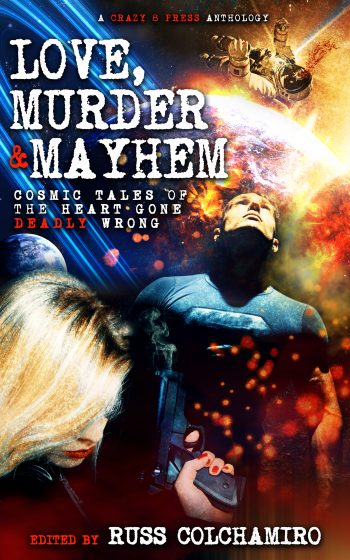 Our new Crazy 8 Press anthology — Love, Murder & Mayhem — came about for purely selfish reasons. And her name is Angela Hardwicke, but I’ll come back to that.
 In the second book, GENIUS DE MILO, I introduced a new character, although just as a cameo. Her name? You guessed it. Angela Hardwicke.
 Russ Colchamiro is the author of the rollicking space adventure, Crossline, the hilarious sci-fi backpacking comedy series, Finders Keepers, Genius de Milo, and Astropalooza, and is editor of the new anthology, Love, Murder & Mayhem. He is a member of Crazy 8 Press.