Category Archives: Uncategorized

Who’s Your Daddy?

By Paul Kupperberg

GogglemanI was listening to a writer being interviewed on NPR the other day and the interviewer asked Stock Question #27: “So out of all your books, which is your favorite?” The write responded with Stock Answer #27: “All my books are like my children. How do you pick a favorite?”

Yeah. Sure. Look, every writer knows when they’ve screwed the pooch and written something that just doesn’t stack up against the rest of what they’ve done, or just flat out sucks. If you’re a believer in Sturgeon’s Law (“90% of everything is crud.”) than 90% of what every writer writes has to be crud (unless you’ve revised it as I have to make it Sturgeon’s Law–Now Improved With Face Saving Rationalization!: “90% of everything by everybody except me is crud.”). But even if you don’t accept the Law, I can understand using Stock Answer #27 instead of responding truthfully; why open yourself up to the follow-up question, “So which one of your books, etc. do you think isn’t so good?” Which can also be asked as, “Which of your books shouldn’t readers waste their money on?”

(See, this is why I only had the one kid.)

But to the question at hand: I do have some books, stories, comic books, whatever that I’ve written that I like more than others. I can’t really think of many things I’ve worked on that I outright hate, even if I wasn’t happy with it at the time I finished it (oh wait…I almost forgot The Adventures of Goggleman, an instructional comic I wrote in 1992 for the Power Tool Institute. I kid you not. “Always wear your safety goggles and always read, understand, and follow the owner’s manual!”). Usually, with the softening effect of a little time and emotional distance between the actual work and taking another look, I find it’s really not as bad as I thought. Maybe not my best but I usually put it down with an, at worst, mildly satisfied, “Well, maybe that didn’t suck as much as I thought.” (Usually, although there’ll be a few epic fails, like the one I discussed here, in an earlier blog post.)

Conversely, there are projects that I’ve pushed away from after typing “the end” and said, “Okay, this almost doesn’t suck!” (That’s understatement, so as not to jinx anything or, as my people say, put the kina horah, or evil eye, on it.)

Jew-JitsuCOVEROne such project was The Same Old Story (available, I’m obliged to remind you, right here from Crazy 8 Press). It was one of those times when, once I got going, everything just seemed to come together and roll merrily along to a wonderfully (to me) satisfying conclusion.

Another of my babies to which I can point with some pride is Jew-Jitsu: The Hebrew Hands of Fury, a humor book I wrote for Kensington Publishing in 2008. It’s written as an instruction manual for a Jewish-based martial arts but is, in reality, a repository of Jewish jokes, Yiddish humor, and silly plays on religious traditions. It’s no longer in print, but if you want to learn such moves as the Davening Headbutt, the Payess of Fury, the Deadly Punch in the Kishkes, and how to use the throwing star of David, it’s still available for the Kindle here.JSAragnaCOVER

The third of my babies was, if you’ll pardon the disturbing comparison, stillborn. In 2004, I signed with Byron Preiss’ iBooks to write a trilogy of Justice Society of America novels. Book One, JSA: Ragnarok was finished in July 2005, just weeks after Byron’s early, tragic death in a traffic accident. Others tried to keep iBooks going, but they weren’t able to hold the company together and were forced to file for Chapter 7 bankruptcy on February 22, 2006…the very week Ragnarok was supposed to go to the printer. I have a PDF of the uncorrected proof, and, within the last year or so, have been in touch with the publishing concern that acquired iBooks’ assets (Ragnarok included) about getting the book to market. However, the new company and DC haven’t been able to come to terms (DC owns the rights to the JSA; the other publisher owns the rights to the manuscript, meaning neither can publish the book without the cooperation of the other) so it’s unlikely Ragnarok will ever make it to print. (You can, however, check out a few excerpts I’ve posted to my website, here, here, here, and here.)

I really do love all my “children,” but as it is with the people we love in our lives, there are some I definitely like better than others. But don’t tell that to Goggleman. There’s really no reason to hurt his feelings.

You Always Remember Your First

Romulan_StratagemA rule of advice to authors is to kill your darlings. You might love a line or a character or a scene but if it does not help the overall work, it should ruthlessly be excised without looking back. But, authors are infrequently asked about which of your darlings would you save. Who is your favorite? Most authors will tell you it’s like asking which of your children you love most. You love them all the same, you tell people.

The truth is we don’t love our written works with equal fervor. Recently, I addressed Time Station Berlin, a work I wish I had a chance to redo.  I’ve written books with zero editorial direction and while good, could have been better. Even with good editorial input I know I could have written a few better but circumstances interfered.  I’ve written books as a favor to the editor so it was a job. I wrote a book on desserts, easily the most boring book I’ve written, because no one else offered me work at the time. So no, I don’t love them all differently.

I’ve written some pieces to take on the personal challenge, as I did when I tackled The Nature of Energy. Not being a science guy, I figured if I could make sense out of it for myself, I can convey that to middle schoolers. A huge baseball fan, I wrote the biography of Wilt Chamberlain just so the editor could see what I can do and be in her mind when a baseball opportunity rolled around leading to the Lou Gehrig assignment.

Out of personal pride, I loved working on The Essential Batman Encyclopedia which may be a bit of esoteric for some but a labor of love and something I remain incredibly proud of. Similarly, I dove into the research with deep interest and feel out of all the young adult work I have done to date, the Bataan Death March was the best of the bunch.

But, do I have an all-time favorite?

Well, you always remember your first. In this case, it was my first solo novel, Star Trek: TNG – The Romulan Stratagem. Having cut my fiction teeth on collaborations, the time had finally come to write something on my own. I relished the notion that we had not really seen Jean-Luc Picard lose a conflict with an opposing race. From that simple concept, I spun a story that brought in the then-underused Romulans and even the emotionally charged figure of Sela. It worked out pretty well and I note over at Goodreads that it remains one of my best reviewed works, which I think still holds up.

And maybe the next one I write will bump that off the pedestal.

An Asimovian Surprise

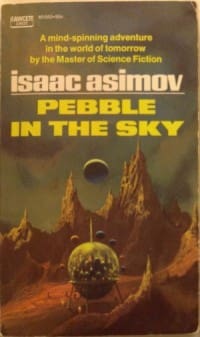
PebblecoverOkay, time to set the Wayback Machine. The year is 1984. I’m fourteen. My parents, my older sister, my two little sisters, and I are up visiting my grandparents in New York. My dad is reading the paper one morning and says, “Hey, Aaron, there’s a science fiction convention in town! Do you want to go?” Now, this is one of the cool things about my parents—neither of them were all that big into genre themselves (although my dad is the one who introduced me to Doctor Who) but they knew I was and had no problem with that. Case in point: the aforementioned exclamation. I, of course, say, “Wow, really? Yeah!”

Next thing I know, my parents are dropping me off at the convention—they give me money for a one-day pass and tell me when they’ll be back to pick me up. Yeah, I know, but different times and all that.

I spend the next few hours wandering the show. It was in a hotel downtown, I don’t remember which one anymore, but it had an enormous ballroom and that’s where they put the dealer’s room. I go from booth to booth, gawking at videotapes and patches and comics and books and posters and action figures and so on. It’s great—I’ve never been to a convention before and I absolutely love it.

Time’s getting short, though, so I start making my way toward the exit, when I see a sign: “Isaac Asimov signing this way.” Wait, what? I’d read Caves of Steel and Foundation and I, Robot and probably a few others, and let’s face it, Asimov was THE MAN. And he was here, at the same con as me? And signing? I had to go for it.

So I find where he’s signing, which happened to be basically a large landing off a staircase that led outside, and I get in line. I don’t have anything for him to sign, mind you—I came to the con with absolutely nothing in hand—but I figure I’ll hand him a flier, a scrap of paper, my shirt, whatever.

I’m still in line when my sister finds me. “Mom and Dad are outside,” she says. “We need to go.”

“I can’t!” I tell her. “It’s Asimov!” And I point to him.

YoungAaron1To her eternal credit, my sister doesn’t scoff. She says, “I’ll tell them,” and leaves. She’s back a few minutes later. “Okay, they’re circling the block.” And she waits with me.

I’m almost to the front when I make a confession: “I don’t have anything for him to sign,” I tell her.

My sister wordlessly reaches into her purse and pulls out a battered paperback copy of Pebble in the Sky. She just happened to be reading it on the trip. She hands it to me.

I have never loved my sister as much as I did at that moment.

My sister and I get to the front, and there’s the man himself. Asimov. He smiles at us, says hello, and holds out his hand for the book. When he takes it he gets this fond look on his face like “ah, hello, old friend!” Clearly this is a book that has been well read. He signs it and hands it back with a thank you. Which blows me away. It’s ASIMOV! And he’s thanking me!

I’m pretty sure my sister had to guide me out of the building and into our parents’ car; I was too stunned to move on my own.

Now I’m an author myself. I’ve written a whole lot of books. I often sign books at conventions. And whenever I do, I always think about how this pioneer of science fiction took the time, not only to sign for fans, but to say hello to each one and to thank them for coming, for reading his books, for liking them.

That’s the kind of man I want to be. It’s the kind of man I hope I am.

And I wonder, from time to time, if my sister still has that paperback. She kept it—it was her book, after all, and she hadn’t finished reading it.

Paul Kupperberg Finds Comedy Magic in The Crimson Keep

Contemplating the Crimson Keep at Shore Leave 2013.

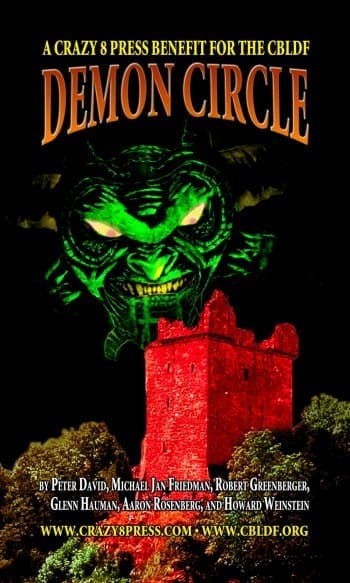
As the newest member of the Crazy 8 Press team, the first I heard of this Crimson Keep dealie was at the group breakfast we held at last summer’s Shore Leave in Maryland. I learned that it was the setting for “Demon Circle,” a short story co-written by the pre-me Crazy 8 writers at 2011’s Shore Leave as part of a fundraising effort for the Comic Book Legal Defense Fund. The idea in 2013 was to create an anthology of Crimson Keep stories to be available at Shore Leave 2014 in celebration of the imprint’s third anniversary.

The ever-efficient Bob Greenberger made sure that we were all provided with a copy of the short story and a mini-bible of its characters and situations, set the deadlines to assure a Labor Day weekend pub date, and off we went to the races.

The thing I took away from “Demon Circle” was the humor. The set-up involves a group of students apprenticed to the magical Master of the Crimson Keep, a castle rumored to have one thousand rooms and one hundred staircases…more or less. The Keep changes, whether by whim or necessity, no one is quite sure, and the apprentices themselves range from braggarts to incompetents to straitlaced, dedicated warriors. Stories could be about any one or all of the above. I went with a solo story about Belid, the wise guy braggart.

Those who know me won’t be surprised by the selection of Belid for my story. Like me, Belid is a terrible student, a dedicated procrastinator, and an unrepentant wiseass, all of which offered me the opportunity to do one of my favorite things: write funny. I don’t mean comedy writing per se, but rather writing with a light touch that lets the reader in on the absurdity of the situation without any outright mockery. Kind of like Douglas Adams, just sans stepping outside of the story to provide observationally wry commentary. It’s the approach I use to write my Leo Persky, Weekly World News reporter of the weird stories for R. Allen Leider’s Hellfire Lounge anthologies (three stories and counting, in volumes 2-4, published by Bold Venture Press) and it’s a wonderfully refreshing break from the more serious voice I usually take in prose.

So, what happens when Belid attempts to evade an upcoming test for which he isn’t prepared by deliberately getting himself lost in the ever-shifting corridors of the Crimson Keep? In this case, he finds himself locked out of the castle and trapped in an enclosed courtyard between “The Wee Folk at the End of the Hall” and their jailers, the bird-like Shadowings. But even while avoiding class, the young apprentice winds up learning a valuable lesson, to wit: No good deed goes unpunished. The trick thereafter is living long enough to apply this hard learned lesson to life.

Tales of the Crimson Keep may have been my first exposure to the world of the Master and his apprentices, but here’s hoping it’s not my last. Like Belid, I’ve still got a lot to learn about this magical and ever-changing place.

Tales of the Crimson Keep will be available in print and digital editions on August 1.

Three Men and a Writer

ScaryTales3Growing up in the 1960s, I was a diehard DC Comics fan. I was also a fan of Marvel and Charlton and Gold Key and Warren and the handful of other publishers than sharing space on America’s comic book spinner racks, but it was DC Comics that stood front and center in my heart. DC’s comics were slick and beautifully produced and, more importantly, they were home to the world’s greatest superheroes: Superman, Batman, Wonder Woman (the only superheroes to survive in their own ongoing titles from the 1940s Golden Age straight through the Comics Wasteland of the 1950s), Aquaman, Green Arrow (who likewise survived the near-death of the superhero genre, albeit as back-up features), the Flash, Green Lantern, the Atom, Adam Strange (just a few of characters which helped jump start the new heroic age of comics that exploded in the 1960s), and many more.

I don’t recall exactly when I realized that there were, somewhere, people who actually produced the comic books that I devoured by the dozens off the rack at the cigar store on Ralph Avenue or the candy store on Remsen Avenue and Avenue B, but by 1964 or so, I was creating my own comic book stories, written and drawn (badly in both instances) on lined loose-leaf paper and in composition books. I suppose it was Marvel Comics, which featured creator credits on page one of every story, that did the trick. Stan Lee, Jack Kirby, Steve Ditko, Don Heck, Dick Ayers, Sam Rosen et al were credited with different aspects of the creation of those stories. Writer. Artist. Inker. Letterer. While math was never my forte, it was easy enough here to put two and two together and see that making comic books was an actual job.

And I wanted it!

I knew I’d never make it as an artist, but coming up with stories was easy for me. I didn’t show these stories to anyone because I was fairly certain they sucked, but I knew I could do it. By the late 1960s I had also discovered fellow comic book fans and comics fandom. By 1971, along with friends Paul Levitz and Steve Gilary, I was about as deeply immersed in said fandom as one could get and, thanks to the exposure afforded me by the fanzines we published (The Comic Reader and Etcetera), more determined than ever to make the jump from fan to professional.

In 1975 that determination lead me to meeting the first of three editors to whom I owe an immeasurable debt of gratitude. Another of those three, DC’s Julius Schwartz, had already left his mark on me through the insanely great comic books he oversaw there, including the aforementioned superhero age jumpstarting Flash, Green Lantern, Atom, Adam Strange, and other titles he edited. I don’t think it’s an overstatement to say (and even if it is, it’s my opinion anyway) that Julie was probably the most influential editor in the history of the medium. His (at the time) thinking man’s approach to comic book story telling was the foundation upon which later editors like Stan Lee were able to build an entirely new direction for comics.

But before I met Julie, there was Wally Green. In late 1974, after about a year of ghostwriting for friends who had proceeded me into the business, I screwed up my courage and sent off a batch of ghost story plots and a couple of sample scripts to Gold Key Comics, which at the time was publishing such anthology titles as The Twilight Zone and Boris Karloff Tales of Mystery. Wally got in touch with me and invited me up to Gold Key’s New York offices to discuss my submissions (I have a vague recollection of them being on Park or Lexington Avenue, but that’s neither here nor there). Like their location, my memory of the exact conversation is lost in the haze of the last forty years, but Wally sat me down and, story idea by story idea, went through my submissions and explained exactly why he wasn’t going to buy them. He explained that there was nothing inherently wrong with any of them, just why they weren’t right for the Gold Key books he edited, and he hoped I would continue submitting stories to him.

Wherever those offices were located, I left them walking on air. I was two blocks away before I realized that I had been soundly rejected…but it didn’t matter. Wally Green, a professional comic book editor, had treated me, a 19-year old wannabe, with the same professional courtesy he would extend to his own stable of writers. And for me, as insecure about my nascent abilities as it got, it was a gift from the Muses. Instead of the standard rejection form letter that I’m sure most editors would have sent out and which would, likely, have left me crushed, I had been given an open, honest, face-to-face critique that was, far from being dismissive, an affirmation and encouragement of whatever talent I showed.

Thank you, Wally Green! You were, and remain in my heart, a mensch among men! (Later, Wally did work, briefly, at DC, at which point I was able to tell him the above story and thank him in person for his warmth and encouragement. His response was to be baffled that an editor would treat any talent, professional or, especially, wannabe, any other way.)

Charlton LetterWally’s encouragement gave me the courage to take those stories rejected by Gold Key and send them off to the editors of Charlton Comics in Derby Connecticut. Not too much later I received a letter from Assistant Managing Editor Nicola Cuti: “We’re accepting “DISTRESS” (See enclosed billing instructions)…The synopses sound good so do them up in script form and we’ll probably take them.”

And, just like that, I was a comic book professional. Charlton paid $5 a page for scripts in those days and the $25 I received for that first story (which was drawn by another relative newcomer named Mike Zeck and appeared in Scary Tales #3 in late 1975) remains the sweetest money I’ve ever received. And, as instructed, I wrote up the other synopses and Nick did take them, and, just like Wally’s professional treatment of me gave me the courage to keep going, Nick’s acceptance of my writing was affirmation that I could in fact make it in comics.

That was validated a few months later when I wrote my first story for DC Comics, a “World of Krypton” back-up for the Denny O’Neil edited Superman Family, my foot in the door at the Crown Jewel (in my eyes anyway) of comic book publishers. That first assignment lead to others, introduction pages for House of Mystery, short stories for anthology titles, an ongoing “Nightwing and Flamebird” back-up, a stint on Aquaman, the New Doom Patrol and, before I knew it, an actual career as a comic book writer.

But…no matter what I wrote, there was still a part of me that wouldn’t believe I had made it until I cracked the hardest and most prestigious nut in the joint: the editorial office of Julius Schwartz. That opportunity finally came by way of a backdoor opening thanks to DC’s licensing of a new toy line from Mattel, “He-Man and the Masters of the Universe.” Editor Dave Manak had, for reasons I don’t recall, asked me to write the MOTU tie-in comic, which consisted of a three issue miniseries, a 16-page insert that ran in one of the company’s advertising groups, and an issue of the Superman team-up title, DC Comics Presents. DCCP was one of the Superman line of books then edited by Julie, but for this one issue he stepped aside to act as “consulting editor” while Dave took care of the bulk of the editorial work.

Julie Schwartz & Me.

I guess I didn’t screw up my handling of Superman too bad, because the next thing I knew, Julie was in my face, growling, “You wanna write an issue of DC Comics Presents for me?”

Uhhh. Yeah.

For the next three or four years, until he gave up the Superman franchise with the coming of Crisis on Infinite Earths in 1985, I found myself a Schwartz office regular, writing dozens of issues of Superman, Action Comics, DC Comics Presents, Superboy, Supergirl, and the daily Superman syndicated newspaper strip. Being one of “Julie’s boys” was, for this fan of 1960s era DC, the ultimate validation. Getting to know this legendary curmudgeon (it was all an act!) was just the icing on the cake.

So thank you, Wally, Nick, and Julie. I’m fairly certain if not for you three gentlemen, I would have had a fine career as a high school English teacher, a valid and worthy profession to be sure…but imagine all the subsequent adventures I would have missed.

Tales of the Crimson Keep Kicks Off 3rd Anniversary Celebration

Demon-Circle-2Crazy 8 Press celebrates its three-year anniversary this summer, and as part of the festivities they will showcase their first ever anthology, Tales of the Crimson Keep.

This collection will feature seven brand new stories from Crazy 8 Press authors Michael Jan Friedman, Peter David, Aaron Rosenberg, Russ Colchamiro, Glenn Hauman, Paul Kupperberg, and Robert Greenberger. Tales of the Crimson Keep, edited by Greenberger, will also feature an introduction by fellow author Kevin Dilmore, whose winning first line inspired the entire concept.

At Shore Leave 2011, Crazy 8 Press solicited opening lines to a story which would be written in round-robin fashion from the show floor. With a dollar donation to the Comic Book Legal Defense Fund, anyone was welcome to contribute a first line during that con’s Meet the Pros event. The following day, at the introductory Crazy 8 Press panel, the one-liners contributed were read aloud, with the audience voting for their favorite line.

Dilmore’s “There’s no way we’re going to get all of this mopped up in time!” was the hands down winner and over the next 36 hours, the Crazy 8 Press authors took turns in the tiniest space available, reviewing notes and writing what ultimately became Demon Circle. Friedman did a final polish and the completed eBook was released soon after with proceeds going to the CBLDF.

Now two years later, Crazy 8 Press is revisiting this spooky realm, with familiar and new characters in stories set before and after the introduction tale, which as an added bonus will be included in the Tales of the Crimson Keep collection. For the Crazy 8 Press authors who were not a part of the story’s creation, it presented an interesting challenge. “I had to be a quick study, tapping into the fiendish part of my writer’s brain.” Colchamiro said. “Wizards, demons, and The Keep itself. Okay, well … here we go.”

JLS_2629Tales of the Crimson Keep will be available in Kindle and Nook formats for $5.99 as of Friday, August 2. The print edition will debut during that evening’s Meet the Pros event at Shore Leave, and then be available through Amazon.

Crazy 8 Press has published more than thirty titles during its first years alone, with new offerings coming this fall, starting with Michael Jan Friedman’s I am the Salamander, the first Crazy 8 Press project to be funded via Kickstarter. As an expanded line of fiction, older works, long out of print, will be brought back beginning with Sir Apropos of Nothing by Peter David.

Additional details of Crazy 8 Press’ future will be unveiled at their panel during Shore Leave in Cockeysville, MD. They cordially invite all to attend.

And keeping with the tradition of The Crimson Keep, who knows what other surprises Crazy 8 Press will unveil …