My great-grandmother Becky was born sometime around 1880, in what was then known as the Pale of Settlement, a chunk of Tsarist Russia where Jews were allowed permanent residency but beyond which they weren’t allow to live. The boundaries of the Pale changed between its establishment in 1791 and its abolishment in 1917, but life in the Jewish settlements (called shtetls, or “little towns”) was about as hard as it got and poverty was the accepted reality. Think Fiddler on the Roof…but minus the Hollywood glamour, singing, and dancing. Becky left the hardscrabble life of the Pale circa 1895 and, as family lore goes, traveled at the age of 16 on her own across country and across an ocean to settle in New York, working at first as a housekeeper for the family of her older brother who had preceded her to America. She would shortly thereafter marry my great-grandfather, have children (including my grandfather, Alfred), become widowed, and raise her kids, grandchildren, and great-grandchildren until her death in 1980 at the (we think) age of 101.
I was born in 1955, when Bubbe (Yiddish for “grandmother”) was 75 years old. This little old (but active until nearly the end) lady was a presence in my life from the very start, one of a slew of strong, amazing women I was surrounded by while growing up. While I loved and appreciated them all (and miss them more and more the older I get), I suppose I took her for granted, the way all kids do their elders. She was Bubbe. Bubbe was always there. Bubbe would always be there. Until, of course, she wasn’t. After her death, and I can’t recall exactly when, I came to a realization about this woman. It was nothing profound or terribly original, just a fact of her life that I had never stopped to think about while she was alive. What it was was this: Becky had been born in a time before automobiles, before airplanes, before even electrification; she lived to see not only the Wright Brothers get off the ground but Neil Armstrong walking on the moon!  Talk about paradigm shifts! That century of her lifespan was the most intensely progressive and inventive of any period in the history of the world up until then. What she thought about all that she had seen and experienced we’ll never know. Nobody ever thought to sit down with her and say, “Bubbe, tell me your stories.” She had spent her much of that time just trying to survive, nurturing the children who survived, mourning those she lost in infancy. Life may not have been as hard in American as it had been in the shtetl, but it was never easy.
What would Bubbe make of today’s world? I can’t even imagine. I’m not sure I even how what I make of it, considering the paradigm shift that’s occurred in my 59 year-long lifespan. When I was born, TV was in black and white and sets were stuffed with vacuum tubes (and weighed about a ton), computers with 1/100,000th the processing power of a calculator I can today buy in a dollar store filled entire rooms, a telephone was something made of solid plastic, had a rotary dial, and was forever tethered to the wall by a cord, and if you wanted to find facts about something, you had to consult a lot of books. Now, a hundred bucks buys me a device that fits in my pocket, goes anywhere I go, and provides all of the above services at the touch of a button.
There’s been equally seismic changes in my field, also linked to the miracle of modern electronics. Publishing, once a purely mechanical (strictly from the technological point of view, of course) operation, has in the course of little more than a decade morphed into an electronic process. Once a manuscript had to be typed onto paper and transferred to cold type and printed by pressing more paper against that type after it had been coated in ink. Now, a book can go from concept to finished product without anyone ever having to handle a physical thing, at least until someone loads the rolls of paper onto the press…unless we’re talking about eBooks, in which case there is never a physical object other than the electronic device on which it’s being viewed. Manuscripts are electronic. Editing is done on the screen. Books are designed, laid out, and prepared for press (or e-distribution) on a computer. The computer has even radically changed the concept of “publisher.” It used to be that the complexity and expense of preparing, printing, storing, and shipping physical books required a corporate entity to back it.
Today, publishing an eBook requires zero up front costs; creating a physical book can be done for next to nothing thanks to print on demand technology; a book doesn’t have to be printed until it’s been ordered. No vast quantities of paper to pay for upfront, no storage costs, no charges for shipping boxes of printed matter (which may or may not sell once it reaches its destination).
 It’s the same for comic books. Used to be a writer would type out a script on paper, mail or hand deliver it to an editor, who would do his voodoo, than ship it out to the pencil artist to draw on oversized sheets of Strathmore drawing board, which would then be shipped back to the editor, who would turn it over to the letterer to put in the balloons, captions, and sound effects, then returned to the editor and sent off to the inker who finished the art in India ink, then back to the editor again for proofreading before being handed off to the production department to make corrections, after which it was Xeroxed down to print size and given to the colorist to be hand-painted with transparent dyes (produced by a company called Dr. Ph Martin), before being sent out for a pre-press process known as color separations which would in turn be used to create the physical printing plates that went on the presses that churned out the finished comic books. Today, I do entire comic book projects without ever having to touch a piece of paper. Sure, artists still draw by hand on paper (well, most…okay, lots…or, you know…some), but after that it gets scanned into the computer and every step after that until printing can be done electronically. Editing, inking, proofing, lettering, coloring, separations…all on screen.
And, like eBooks, they don’t have to be printed to be seen. Just click the “buy” button on the program of your choice and read your favorite funnies on your phone, tablet, or PC. Concurrent with the paradigm shift wrought by technology is another, more ominous change that’s been creeping through publishing of books and comics (and films as well) for several years now. That’s the idea that it’s better to publish (or produce) one major, blowout, mega-hit book (or comic or movie) than a dozen smaller projects. I recognize the economic sense in this; paying to produce and advertise a single book that sells a million copies is cheaper than the cost of 12 separate titles that sell 80,000 copies each. But from an aesthetic point of view, it means that there are 11 good books that those 80,000 potential readers will never get a chance to see. It narrows the field and the chances of writers who aren’t J.K. Rowling or John Grisham of getting published.
 As it was in Bubbe’s world, these changes are massive and, even for someone like me who grew up on Star Trek and science fiction in the 1960s, unimaginable just a few years ago. Was Bubbe better off with modern technology over the primitive conditions and crushing poverty into which she was born? Absolutely. Did much of it really have an impact on her day-to-day life? Electricity and running water aside, probably not, but it was there nonetheless, the advantages available when needed.
Are we better off with computers and print on demand books than we were back in the analog days? Well…yes. And no.
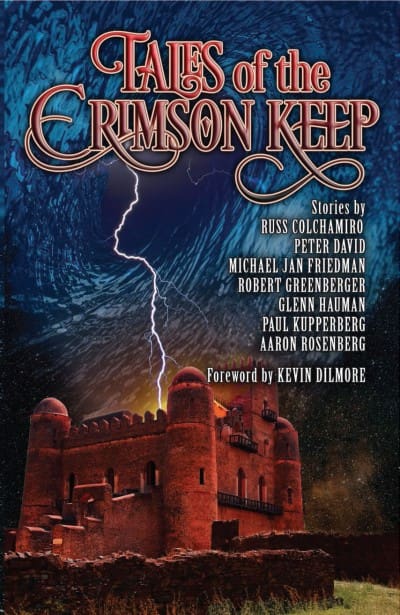
The ease of publishing books has made it so anyone can do it and, from what I can tell by the proliferation of eBooks out there, everyone does. It’s democratized publishing, true, but that’s just made it more difficult for professional writers like we here at Crazy 8 Press to break through the clutter and noise so our readers know we’re here. But we’re all, to a writer, storytellers and we’ll continue telling our stories and trust (hope?) that, thanks to all this newfangled tech, we will be found by readers. But in the numbers we would be found if we were published by Penguin Books or Random House or Simon and Schuster? It happens, sure…but not often.
As I’ve done with books, I’m also doing now with comic books. The major comic publishers have become stunt-driven crossover event-crazy mishmashes of endless, overlapping “epics” that are, to say the least, not to my taste. Okay, as the writer of the recent “Death of Archie” storyline I’m not entirely without sin in this area (although I hope I was able to give readers the added value of a good, emotionally true story with their slice of stunt), but it was the exception to my current comics writing, not the rule.
The rule, these days, is the work I’m doing at a small start-up called Charlton Neo, where a small group of Facebook friends came together to revive the beloved, 30-year defunct Charlton name with new stories and art, created not for the money (whew, talk about an understatement!) but for the pure love of the material. What started as a fun little small print run comic book is slowly evolving into an entire line, featuring new stories by old timers like me and a slate of new talent that is, frankly, knocking my socks off with what they’re doing. I’ve written about 130 pages of new material (and counting!) for the Charlton Neo books in progress, from anthology titles in genres from Western to horror to funny animals, as well as two issues of Paul Kupperberg’s Secret Romances, a romance anthology that proves “happily ever after” isn’t what it used to be.
As with Crazy 8, I can’t believe the array of talent I get to work with at Charlton Neo (do please check us out at CharltonNeo.blogspot.com; you’ll be impressed, too). Crazy 8 and Neo are both, without question, labors of love…possible, paradoxically only because of the paradigm shift in publishing that has, in other ways, affected many of us in negative ways. Would I ever want to go back to the old ways? In some regards, maybe…except that would also mean losing the breathless excitement and wonder of being part of two such amazing, dynamic creative communities. And while there are struggles even in that, just as I’m sure Bubbe would never have wanted to return to the shtetl despite the hardships of emigrant life in Brownsville, Brooklyn, I’m happy to take up residence in this New World in which I now find myself.
So, paradigms, keep shifting. We’ll adapt. If a 4-foot-something tall little Jewish woman who came to the U.S. from the middle of nowhere without knowing the language or customs could do it, I suppose I can too.