The DuckBob Q & A with Aaron Rosenberg!

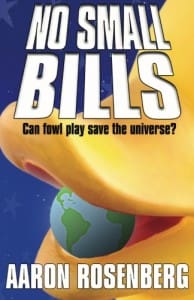
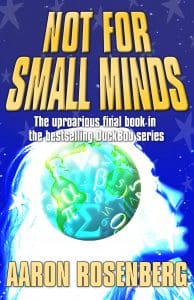
Aaron Rosenberg — a best-selling author and founding member of Crazy 8 Press — is back again with his latest scifi comedy novel in the Duckbob Spinowitz Adventures, Not for Small Minds.
*   *   *

Q: For those not familiar with your Duckbob character… um… how exactly is it that he’s a… well… a duck… man? Who happens to be the key to saving the Universe? (Full disclosure, milk shot through my nose as I typed those words)

A: Right, so the short version—Bob Spinowitz is a regular guy who got abducted by aliens (the “Grays,” the ones you see in all those movies and TV shows and documentaries) and they altered him into this man-duck hybrid. Then dumped him by the side of the road and left him to pick up his life from there. He changed his name to “DuckBob” because he figured people would call him that anyway so why not defang them a bit by beating them to the punch?

Q: Sure, sure. So… Not for Small Minds is the fourth and — so far as you’ve said — the last novel in your DuckBob scifi comedy series. How does it feel to be at the end?

A: Both good and sad. I really like writing DuckBob, he’s a great character with a great voice, so I’m a little sorry there won’t be more novels. At the same time, I’ve always told myself I wouldn’t be one of those people who wrote twenty-seven books in a series that really should have been only three. There’s a natural rhythm to these things, some stories are meant to go on and others are meant to end. I feel like I’ve finished DuckBob’s big story here and I’m happy with the results. To write another novel would feel like I was dragging things out, and I’d worry that I was diminishing him and his voice by stretching it past what was intended.

Q: The first three books in the series — No Small Bills, Too Small for Tall, and Three Small Coinkydinks — focused on Duckbob, Tall, and then Ned. Not for Small Minds puts Mary front and center. What was your biggest challenge — and your goal — for giving Mary center stage?
A: The biggest challenge was that I really wanted this to be Mary’s book, not DuckBob’s. But he’s the narrator, and he has a very . . . strong personality. Which meant I had to be very careful to let Mary, who tends to be more soft-spoken, shine on her own even though it’s all through his words. I also had to be careful because DuckBob absolutely adores Mary—as he should—but that means he sees her as this perfect being. Since this is Mary’s story, I needed to make sure her flaws were visible as well, so that we’d be able to relate to her properly and not see her as some idealized figure.

Q: Beyond the obvious — Duckbob and team rush to save the Universe again — what’s the gist of Not for Small Minds?

A: Mary invites DuckBob to accompany her to her college reunion. He jumps at the chance to see something of her past, but is a bit dismayed when he does. Then they’re summoned by the Grays to deal with the invaders from another reality once again—only this time it’s the Grays themselves who are under attack! Mary and DuckBob have to figure out how to rescue the Grays and deal with the invaders once and for all, but it’s going to take more than just them and Tall and Ned to accomplish that. They need a lot of help, which they get from the unlikeliest places, and that creates problems of its own.

Q: Scifi comedy — as a subgenre — seems to go in and out of favor in the public consciousness. What attracts you to this type of story?

A: You know, I love SF comedy. I have since I was a kid. I remember reading Ron Goulart’s Calling Dr. Patchwork and Harry Harrison’s The Stainless Steel Rat and loving them. Then of course there was The Hitchhiker’s Guide to the Galaxy, which just took things to a whole new level. Science fiction is one of those genres like fantasy that can blend with almost any other genre and can range in tone from incredibly serious to ridiculously silly but I tend to prefer the silly—I think being able to explore new worlds and other races and technologies so advanced they seem like magic just lends itself to the absurd, which in turn allows you to highlight human nature and values like love and loyalty and friendship and how those can endure in even the wildest circumstances.

Q: In addition to the novels, you’ve also written a handful of Duckbob short stories, which, I’m here to say, are hilarious! Any chance we’ll see more Duckbob in the future? (please please please!)

A: Ha, yes, we’ll definitely see DuckBob again in short stories! I’m pretty sure he won’t let me shut him up permanently! He’s actually really well suited to the short story length, and that allows me to tell fun one-offs about him and his friends without having to worry about tying them into a bigger story. Eventually, if there are enough of them, I may collect all the stories into a DuckBob anthology, but we’ll see.

Q: Thanks Aaron! Where can new and returning fans find Not for Small Minds — and the entire Duckbob series?

A: My pleasure! You can find all the DuckBob Spinowitz Adventures here on the Crazy 8 Press site. They’re also available through Amazon and Barnes & Noble .

*   *   *

Aaron Rosenberg is the author of the best-selling DuckBob SF comedy series, the Dread Remora space-opera series, the Relicant epic fantasy series with Steve Savile, and the O.C.L.T. occult thriller series with David Niall Wilson. Aaron’s tie-in work contains novels for Star Trek, Warhammer, World of WarCraft, Stargate: Atlantis, Shadowrun, Eureka, and more. He has written children’s books (including the original series STEM Squad and Pete and Penny’s Pizza Puzzles, the award-winning Bandslam: The Junior Novel, and the #1 best-selling 42: The Jackie Robinson Story), educational books on a variety of topics, and over seventy roleplaying games (such as the original games Asylum, Spookshow, and Chosen, work for White Wolf, Wizards of the Coast, Fantasy Flight, Pinnacle, and many others, and both the Origins Award-winning Gamemastering Secrets and the Gold ENnie-winning Lure of the Lich Lord). He is the co-creator of the ReDeus series, and a founding member of Crazy 8 Press. Aaron lives in New York with his family. You can follow him online at gryphonrose.com, on Facebook at facebook.com/gryphonrose, and on Twitter @gryphonrose.

Peter David visits the Crimson Keep on his Own

Writing is, by and large, the loneliest profession you can undertake.  It’s not like a typical office job where, if you run into problems, you can go to your supervisor and get some guidance from him or her.  It’s not like your friends can inform you about a procedure you didn’t know about that will solve the situation for you.  In writing, there’s you and the computer screen and that’s it.  It’s your story to tell:  Not your editor’s and not your fellow writers, neither of whom is in your office to pitch in any way.

The Crimson Keep stories haven’t been that way.  Crimson Keep began when Crazy 8 launched a round robin challenge at Shore Leave many years ago.  We took turns wedging our bodies (easier for the skinny guys; more problematic for me) into a space between two brick pillars and produced the very first combined Crazy 8 combined writing endeavor.  Each of us had an hour to come up with our contribution, which naturally became more challenging the further in we went because there was more for each new writer to read.  Should really have given the later writers ninety minutes, now that I think back on it.

We later did a second group story, minus the part about sitting at a convention.  The only hitch with both group stories is this:  I have no recollection which parts of the stories were mine.   Just as it’s difficult for writers who are undertaking a group effort to, say, write a sitcom script, it’s hard to remember which joke was whose.

That was solved when we planned Tales of the Crimson Keep, in which each of us would contribute our own story to the endeavor.  I wasn’t sure what I could come up with that wouldn’t step on somebody else’s undertaking, and eventually, I seized upon an idea that had been done in a couple of episodes of Xena, Warrior Princess.  I would come up with a story set in an entirely different time period and have the characters “reincarnated” so that they looked and sounded identical to the way they used to be, but had no recollection of their previous lives.  Toss in a young man from the Keep who had been trapped for centuries, set it during World War II so we could have Nazis for our villains, and the story practically wrote itself.

If you are encountering the Keep for the first time, welcome to the magic show.  If you’ve been following us all this time, thank you for your support and patronage.

Tales of the Crimson Keep – Newly Renovated Edition is now on sale in the usual variety of formats.

Mary Fan Visits the Crimson Keep

Want to know a fun fact? Contributing to Tales of the Crimson Keep was the first time I’d written in an already-established world. It was both exciting and a bit intimidating—as most new things are. As far as sandboxes go, the Crimson Keep was a pretty vast and flexible one. The premise of an ever-changing fortress with unlimited possibilities within the walls meant that nearly anything was possible.

At the same time, the first edition of the anthology was already out, and there’d already been many stories set in this world. The last thing I wanted was to write something that would be inconsistent with what was established.

The first thing I did was read every scrap of the first edition to get a feel for what kinds of stories fell into the world of the Crimson Keep. The answer: many kinds. Some were funny, and some were more serious. But all felt like they were skating across a glimmering pool of whimsy.

I decided to leave the established characters be and introduce the Keep to someone new: a visitor from another part of the world who, like me, was seeing the Keep for the first time. And so I created the character of Meilin, a girl who came all the way from the Far East on a quest to the Keep. How fascinated would she be by the fortress’ dangers and charms? How much trouble would she run into?

Of course, I couldn’t just let her run amok in the Keep. I had to send someone along to make her life even more different. I’m not entirely sure why I settled on a childlike, chaotic neutral spirit with phenomenal supernatural powers and the eternal mental age of a kindergartner. Maybe it was because that seemed to me to be the embodiment of the Keep’s fanciful nature.

The story’s title, “Glisk of the Keep,” is a double entendre. I’d recently learned of the word “glisk,” which can mean either refer to light (e.g. rays spilling through clouds, a glint in one’s eye) or mean “glimpse.” Somehow, it seemed to fit my mischievous spirit, who lived in the Keep and caused trouble for all within its walls. But since “glisk” also means “glimpse,” and Meilin would only get to see a small part of the fortress (since she’s a visitor and not a resident of it), it also seemed to fit with the story.

I hope you’ll check out my story in the newly renovated Tales of the Crimson Keep and have as much fun reading it as I did writing it!

Tales of the Crimson Keep – Newly Renovated Edition is now available at your favorite booksellers.

Russ Colchamiro Writes of Thieves in Night – Tales of the Crimson Keep

Talk about a long time coming.

More than 25 years ago, while I was still in college, I had an idea for a story of some kind: two thieves who, by happenstance, happen to rob the same house at the same time.

It was an amusing scenario, and I had a few of the details filled in, but I didn’t have a full blown story I wanted to tell. It needed a hook. I didn’t have one.

The story was never far from my thoughts — I knew I wanted to do something with it — but there it lived, furtively, quietly, in a drawer, and lingering like an ancient mist in the back of my mind.

Enter Crazy 8 Press.

Enter Tales of the Crimson Keep.

The Keep has wizards and ghouls. Magic and spells. Secrets. And, of course, the Keep itself.

In a flash the story that had been percolating for all those years finally had an elixir. I was able to conjure the tale. The hook was provided for me.

And so I bring you “Thief in the Night”.

The core is still there, two thieves with the same target. But this tale being part of an anthology filled with magic, demons… and danger… their night of burglary in no way ends the way either of them had in mind.

But that’s the thing about being a thief. No matter how much you plan and plot, you aren’t the only thing that goes bump in the night.

Enjoy.

Tales of the Crimson Keep the Newly Renovated edition will be out later this month.

Crimson Keep: We Got You Covered

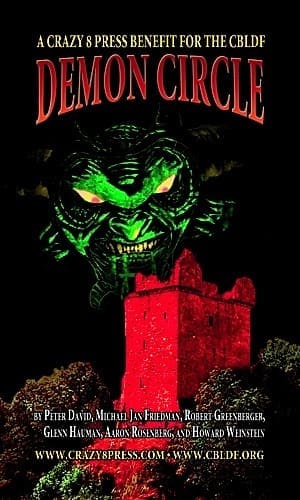
When we wrote the first Crimson Keep story, “Demon Circle,” we really didn’t know what we were getting into. That’s because, up until Kevin Dilmore provided the opening line at our Crazy 8 panel on the first day of that ShoreLeave when we were going to be writing the story on-site in round-robin fashion, we didn’t have any idea how the story was even going to start, let alone where it was going to go. We didn’t know what kind of story it was, what genre it would be in, what the tone would be, any of that. It was only as we wrote that we figured all of that out—the story grew from author to author, developing itself under our fingers, until by the end we had a fully formed fantasy tale.

Then we had to come up with a cover.

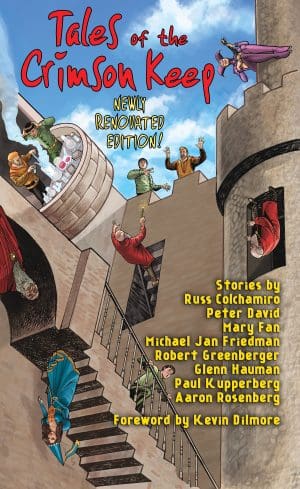
Glenn took care of the first one, and the image was evocative if a little dark for such a goofy story. When we went back into that world and each wrote our own stories there, then collected all of those plus “Demon Circle” in the original Tales of the Crimson Keep, he built that cover as well. And you can tell at first glance that this is a collection of fantasy stories.

What you can’t tell is that they’re fun, and even funny, rather than dark and serious. This isn’t grim and bloody fantasy, it’s much lighter than that.

Which is why, when we decided to go back in and revise and expand and re-release the anthology—now with a new story by our newest C8 member, Mary Fan, plus an all-new round-robin story by all eight of us—I suggested that we would need an all-new and completely different cover.

Bob, Russ, and I discussed our requirements. “Think light-hearted,” I suggested. “Robert Asprin’s Myth Adventures series. John DeChancie’s Castle Perilous series. Heck, Piers Anthony’s Xanth series! The cover needs to say ‘fantasy’ but it also needs to say ‘fun.’”

Bob talked to our artist, Ty Templeton, and Ty did up some sketches. He sent us six of them, including one that he didn’t think would actually work because it was too busy.

I loved it. “That’s the one,” I said. “It looks like M.C. Escher meets Monty Python.”

Ty said okay, he’d give it a shot. And when he sent in the final, all three of us felt that it was perfect.

I think you can agree that now, when you pick up Tales of The Crimson Keep, you know that you’re definitely getting fantasy stories but you’re also in for a whole lot of fun. Almost as much fun as we had writing them.

Tales of the Crimson Keep – Newly Renovated Edition will be available in August.

Dear Professor Birthday Boy…

Dear Professor Birthday Boy Bob:

Please excuse Glenn from completing his essay, “Keep Crimson Tied: BDSM Themes In Funny Fantasy Anthologies” as he is dead.

Glenn was killed repeatedly by numerous science fiction and fantasy authors, artists, and according to this eyewitness depiction by Lar DeSouza, some 15-year-old girls on a furry anime kick.

Glenn appreciates your understanding that death finally turns out to have an advantage. Rest assured, he will be back to life soon and will contribute between times in the grave.

Signed,

Epstein’s mother

Tales of the Crimson Keep – Newly Renovated Edition will be on sale in August.

Crazy Good Stories