All posts by Paul Kupperberg

My Favorite/Most Influential Anthology: Danger Visions

By Paul Kupperberg

I don’t read many anthologies these days. Maybe I should. I’ll usually read those containing one of my stories, like the upcoming Thrilling Adventure Yarns, edited by my friend Bob Greenberger and featuring my short barbarian adventure story, “Dreams of Kingdom,” but it’s been decades since they were regulars in my to-read pile.

I used to read them by the stack when I was kid, back in the 1960s. Science fiction, fantasy, sword and sorcery, mysteries, and even literary anthologies (once I discovered literature). Anthologies are like treasure chests full of every conceivable kind of wealth, no two objects alike. If you don’t like one story, chances are the next one (or the one after that) will be more to your liking.

The first anthology I remember reading was Dangerous Visions, Harlan Ellison’s groundbreaking 1967 collection of state-of-the-art-and-beyond science fiction short stories by the elite of science fiction, past and present, from Isaac Asimov to Robert Zelazny. This 500-plus page tome took the SF community by storm, and it was home to that year’s Hugo Award winners for best novella (“Riders of the Purple Sage” by Philip Jose Farmer) and best novelette, “Gonna Roll the Bones” by Fritz Lieber (which also won the Nebula), and the Nebula Awarded best short story, “Aye, and Gomorrah” by Samuel R. Delany.

I came into possession of Dangerous Visions through the good people at the legendary Science Fiction Book Club, a creation of publisher Doubleday in 1953. It was genre specific “book of the month” club’; members would be sent a mailing offering each month’s book to accept or reject. Send back the postcard to reject it and nothing happen. Accept it—or neglect to mail back the postcard by the deadline, as was most often the case—and the book would be sent, along with a bill. The service’s come-on offer to new customers was something like “eight books for a nickel,” which came with the caveat that they also buy a certain number of books during the year.

I joined the SFBC sometime in 1968 or 1969 and one of my freebies was Dangerous Visions. I don’t have an actual photograph of any of the instances when what I was reading made my head explode, but explode it did. Repeatedly. I had been reading science fiction for a couple of years, lots of Asimov, Heinlein, and Clark, and the stories in DV weren’t anything like I had come to expect. These stories were grown up (I was thirteen or fourteen). I had only recently discovered “New Wave” literature, but this was “New Wave” science fiction. Characters cussed. Had sex. The very first story in the volume, by Lester del Rey, was about man capturing and usurping God; “Evensong” was one of many of the thirty-three stories in that book I’d reread years later and finally, really, understand. These weren’t your talky (but entertaining) Asimov pulp magazine sci-fi tales. This was serious stuff.

But the greatest service DV did me was to introduce me to a slew of new, unfamiliar authors. Brian W. Aldiss, Alfred Bester, Norman Spinrad, Farmer…even editor Harlan Ellison himself, a good chunk of whose oeuvre I went on to devour into my twenties. DV was quite literally my doorway into serious science fiction, the anthology that turned me from a casual reader to a fan.

Fifty years later, I no longer read much science fiction and, except for a few favorite volumes like Clarke’s Childhood’s End, Asimov’s Foundation Trilogy, and a handful of titles by Bester, I no longer keep a lot of it on my shelves. But I still own my half a century old edition of Dangerous Visions, and it’s 1972 follow-up, Again, Dangerous Visions (a third, The Last Dangerous Visions, due originally in 1973, has assumed the status of Bigfoot and the Loch Ness Monster, often believed to have been spotted, but never captured). Both books have been read, repeatedly. I recently lent DV to my son, so he could read it, and, as father used to say to me, “learn what’s what!”

I didn’t know when I ordered it as one of my “eight free books for a nickel” what worlds Dangerous Visions would open up for me. I was already on the road to being a voracious reader, but that one anthology not only fed my hunger, it helped make me a discriminating reader. It inspired me to read other anthologies, science fiction and other genres, and to seek out magazines like New Yorker, Esquire, and Evergreen Review for the cutting edge literary short stories they published. It even gave me the courage to start writing my own “serious” short stories, experimenting with style and subject matter beyond secret agents and superheroes. I didn’t finish ninety percent of them, but at the time, just scribbling even incomplete stories on the lined pages of spiral-bound notebooks was a major victory.

So…I hope you’ll support the Thrilling Adventure Yarns Kickstarter campaign currently underway. Who knows? One day it might just be the anthology that inspires some other young writer to take his pen to paper and create his own thrilling yarns.

Sword & Sorcery & Schmaltz

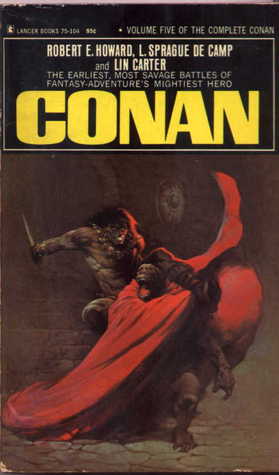
The first sword and sorcery I ever read was Robert E. Howard’s Conan, in the books published in the mid-1960s in paperback by Lancer Books, with the soon to become iconic cover paintings by Frank Frazetta. My father had brought home a recently published paperback edition of Tarzan of the Apes by Edgar Rice Burroughs that someone had left behind at his office. I recognized the Ape Man from the movies I’d seen on TV, but I wasn’t prepared for what I read. It was like I had discovered the real-life version of what was, essentially, portrayed as a grunting cartoon character in the movies. It floored me. I still think it’s a great novel, as close to literature as pulp fiction got when it was published in 1912. I reread it every few years.

My next trip to the library after that included a hunt for more ERB. I was rewarded with John Carter of Mars (so…score!), which was my gateway to sword & sorcery. As I recall, it was on a later library visit that I spotted Conan on the paperback rack, where the librarian told me I might find some more ERB books. Conan was hard to miss: a dark scene of a ripped barbarian in a life and death struggle with a gorilla wearing a startling crimson cloak!

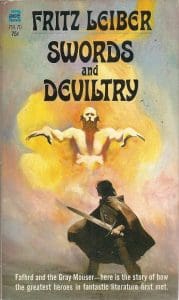
Like toppling dominos, that library paperback spinner rack Conan (the best things in my childhood were sold on spinner racks!) lead to Michael Moorcock’s Elric and Eternal Warrior and Lin Carter’s Thongor and to L. Sprague DeCamp and Andrew J. Offutt and the rest of the 1960s explosion of S&S authors, including Fritz’s Lieber’s Fafnir and the Gray Mouser.

Fafnir and the Gray Mouser stood out from the barbaric crowd. First, they weren’t exactly barbarians. I mean, technically sure, the giant swordsman and minstrel Fafnir and his partner, the diminutive former wizard’s apprentice and swordsman hailed from barbaric roots, but they were more sophisticated and cosmopolitan than their loin-cloth wearing brethren. Fafnir and the Mouser were rogues and more true-to-life, characters who acted in the world instead of just reacting. Not only were Lieber’s stories witty, his characters had senses of humor. No grim and gritty angst-filled monologues for these cheating, brawling, larcenous, wenching adventurers. Their swords were for hire and life was good.

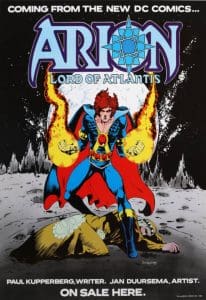
Unfortunately, when I finally got to create my own sword and sorcery character for DC Comics in 1982, I seemed to have forgotten the wit. The very first installment of Arion, Lord of Atlantis (appearing as a back-up in Mike Grell’s Warlord #55 (March, 1982) opens with steely-eyed warriors ominously eyeing the coming storm and angsty young Arion spouting his ominous feelings in pseudo-Shakespearean tones. The series (which was co-created with artist Jan Duursema and ran for eight issues in the back of Warlord, and thirty-five issues plus a one-shot in its own title) wasn’t entirely without humor; I always had a knack for witty dialog, but the tone of the series was dry and serious.

I fixed that but good in 1992 when I revived the character in 1992’s Arion the Immortal miniseries (with art by Ron Wilson). It’s 45,000 years later, Atlantis has long sunk beneath the sea (taking all but the most minute bits of powerful magic with it), and there’s a colony of surviving Atlantean deities living in modern-day New York City. Arion is one of them, the quintessential “you kids get off my lawn or I’ll turn the hose on you!” old man, wrinkled and frail looking. He lives in a one-room apartment over Carnegie Hall and makes his living as a three-card monte dealer in Times Square. His ancient foe owns a deli on the Lower East Side that he eats in all the time. And when the magic returns, making Arion young again, well, chaotic hilarity ensued.

These days, it’s hard to keep humor out of my writing, the more cynical or darker the better. That’s why when I was presented with the world of the Crimson Keep in which to write a short story shortly after being inducted into the ranks (you don’t know how rank sometimes!) of Crazy 8 Press, I had no problem coming up with “The Wee Folk at the End of the Hall” for the 2015 Tales of the Crimson Keep anthology. The world and characters in which this was set had been created by Peter David, Michael Jan Friedman, Robert Greenberger, Glenn Hauman, and Aaron Rosenberg in “Demon Circle,” a round-robin story written live at a convention in support of the Comic Book Legend Defense Fund.

The Crimson Keep is home to an old wizard and his apprentices, but it’s not exactly a steady home. The rooms and corridors and stairways in the Keep are constantly shifting and changing. Stray from well-used routes between familiar rooms and you can be lost for days or weeks or forever in the infinitely-possible layout. And, seeing as how my Crazy 8 comprades are no slouches at the funny themselves (except for Hauman, but we take care of him in They Keep Killing Glenn…now on sale!), there’s ample opportunities for wit built right into the concept.

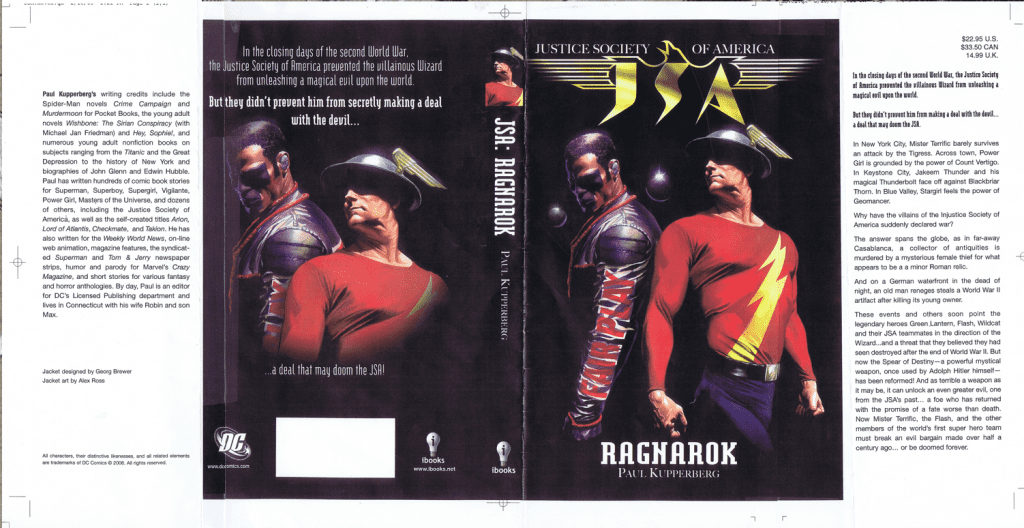
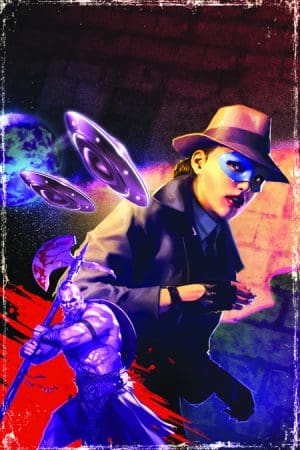
Which brings us to Tales of the Crimson Keep: The Newly Renovated Edition, featuring not one but two (count ‘em, two!) new stories. The first is “Glisk of the Keep” by the newest addition to the C8 crew, Mary Fan. The second is “Poor Wandering Ones,” a poignant round-robin tale by all eight of the Crazy 8. All that…plus an eye-popping new cover by the amazing Ty Templeton.

I’ve feel like I’ve come a long way since Conan!

Tales of the Crimson Keep: The Newly Renovated Edition will go on sale later this month.

One Hundred Stories

“Smooth Talk” (Saturday, August 19, 2017) My father Sidney with a model at the Lincoln Terrace Camera Club

Here’s a little cautionary tale from the life of one of the Crazy 8 Press crew. Don’t worry, it’s not too long, you won’t learn anything of lasting value, and it’s illustrated with cool old black and white photos of New York City and old bums, and it has a link to free content. Who doesn’t like free content, right?

# # #

Today, I posted my one hundredth and final flash fiction story (well, really only ninety-nine of them are mine) on Tumblr, all written in the last one hundred and five days. (Click me! Click me! You can find all one hundred stories right here…or click on the pictures to go directly to those stories!)

Every morning since June 1, I awoke to a stack of old black and white photographs and a self-imposed task, the meeting of which only I had any reason to care about. No, I take that back. Even I didn’t have any real reason to care about meeting this ridiculous story-a-day deadline I’d inflicted upon myself, but once I got started, it was hard to stop.

What happened was, I was looking for some way in which to showcase some of the photographs taken in and around New York City more than two-thirds of a century ago by my father, Sidney (1921-1992). Sidney picked up a camera shortly after World War II, joined a bunch of camera clubs and photography organizations, learned how to process and print his own film, and over the course of the next decade and a half, took thousands of pictures.

“No Reservation” (Tuesday, August 29, 2017)

One of his favorite subjects was the area of lower Manhattan known as the Bowery, then a rough neighborhood overshadowed by the Third Avenue elevated subway line. The Bowery was, according to a 1919 magazine article, “filled with employment agencies, cheap clothing and knickknack stores, cheap moving-picture shows, cheap lodging-houses, cheap eating-houses, cheap saloons,” with a reputation as the city’s “Skid Row.” The Bowery was little changed in 1950, an age in which there were no sympathetic synonyms for the vagrant population he recorded with his camera.

“Life Support” (Sunday, August 6, 2017)

I’ve been looking at many of these photographs for my entire life. I’ve had a half dozen framed photos hanging in my home for decades, but it wasn’t until recently that I was able to gather them all in one place and look at the body of his work.

Now, show the non-writer type a photograph and their response is usually to the photograph, such as its subject matter, it’s location or composition, or the way light and shadow play against one another.

Not the writer, though. The first thing we do is zero in on the faces or the way someone is standing and think, “I wonder what his story is?” A picture, whether it’s a posed or a candid shot, is a moment frozen in time that can capture something of the heart and mind of its subject, making it worth the proverbial “thousand words.”

Not that we can ever know what was actually going on in their minds at the moment the shutter snapped and captured them for all time. But we can certainly see the raw, base emotion in their eyes and expressions and that’s all a writer really needs to get started.

“His Lucky Day” (Thursday, June 1, 2017)

Looking through the photos, I started to see the stories in many of them. The first story, “His Lucky Day,” written and posted on June 1, just about leapt out at me, a tiny moment in time, of significance to no one but the lucky man himself. Not every story came so easily; some photos I looked at every day for weeks or months until they revealed their stories to me. Others started off going in one direction, only to take a sharp turn somewhere along the way and become something altogether different. But all of them brought me back to a time and place that still bore a resemblance to the New York I remember as a little boy, even if the Third Avenue Elevated line was gone before I was born.

Among the stash of photographs are countless family snapshots, candid and posed, and shots of my father and his friends, clowning around on the street or in front of the neighborhood candy store. I started to include those in my story-a-day series, featuring my parents, brother, grandparents, aunts, uncles, cousins, even myself in one story, based on a picture of me with my great-grandmother.

“September 1955” (Saturday, June 24, 2017) Three-month old me with my great-grandmother, Becky Kupperberg

There are about a dozen photos for which I wrote a haiku or used a one-liner to satisfy my daily quota (because some days, I just needed a break!), but the one hundred flash fiction stories (some are more “flash” than others) based on one hundred photographs clock in at around 34,000 words, including the five hundred words of the one hundredth and final photo flash fiction story, a piece of memoir written by my father for a writing class he took during his retirement years, “Whistling in the Dark.”

“Whistling in the Dark” (Wednesday, September 13, 2017)

I thought it only proper Sidney should have the last word and picture.

Photographs by Sidney Kupperberg

© Paul Kupperberg

Love, Murder, Mayhem – Write What You Know…A**hole!


“The Case of the Missing Alien Baby Mama” is my fourth outing with Leo Persky, “a solid five foot seven, one hundred and forty-two pounds of average, complete with glasses, too much nose, not enough chin, and a spreading bald spot that I swear isn’t the reason I always wear a hat.”

Leo was born in 2008, when I was invited to contribute a short story to an anthology published by Moonstone Books. I’d dabbled in horror before, but in that broody-meant-to-chilling kind of way, so I wanted to do something a little different this time around. That I had been, up until several months earlier, a writer for and executive editor of the fake news humor tabloid Weekly World News probably had a lot to do with my decision to take a little tongue-in-cheek poke at the conventions of the form.

So Leo Perksy, under the penname of Terrance Strange and a picture of his much more photogenic grandfather, is an investigative reporter for WWN. In Leo’s world, everything the News prints, from ghost stories to interviews with alien visitors is the one hundred percent, fact-checked and verified truth. And to say that Leo views his world through jaundiced eyes would be an understatement; Leo is a proud, self-proclaimed snarky asshole because, well, everybody always tells me I should write what I know.

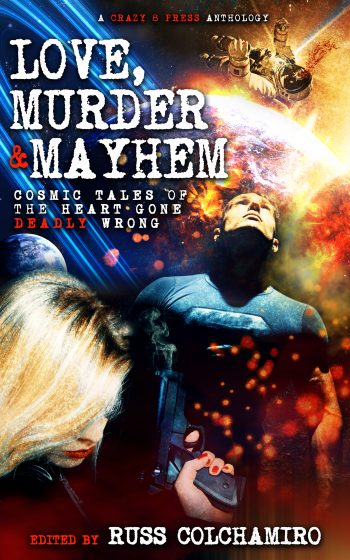
Two more Leo stories followed “Man Bites Dog,” “Vodka Martini, Straight Up, Hold the Jinn” (2012) and “Shunning the Frumious Bandersnatch” (2014), both for horror anthologies.* Then, in 2016 came Russ Colchamiro’s call for stories for the Love, Murder, and Mayhem anthology we’re doing through Crazy 8 Press. Russ had only one rule: “Each story within the SciFi realm must contain at least one component of love or romance, and at least one murder. Mayhem always welcome.”

Funny he should say that, because after finishing “Shunning the Frumious Bandersnatch,” I realized that all three of Leo’s stories had supernatural elements—vampires, genies, and Atlantean magic—and I hoped that in the next outing, I could do something with those other staples of WWN headlines, alien visitations and interspecies progeny, especially human/alien hybrid babies. Within twenty-four hours of Russ’s email invite, we had an approved pitch for “The Case of the Missing Alien Baby Mama.”

And now that alien baby is about to be born, an adorable little tale complete with the requisite love and murder, as well as its fair share of mayhem. As just one of the parents of this beautiful, bouncing newborn book, I couldn’t be prouder.

Love, Murder & Mayhem from Crazy 8 Press will be on sale both in print and digital formats in July. Stay tuned for updates!

*The previous Leo stories are collected in one handy, dandy Crazy 8 Press volume, In My Shorts: Hitler’s Bellhop and Other Stories.

(By the way, if you’re unfamiliar with the “real” Weekly World News or want to revisit that funny old friend, you’ll find an archive of back issues online.

You can follow Paul at PaulKupperberg.com and on Facebook and Twitter. He is a member of Crazy 8 Press.


Free Fiction: “So That’s What Happened to Ernie”

UntitledBy Paul Kupperberg

The three old men were long finished with their breakfast and were loitering in the corner booth with their coffee over a table of dirty dishes waiting to be cleared. They sprawled with the easy familiarity of their years, talking in deep, rumpling voices that periodically erupted in raspy, phlegm filled laughter.

Sam, whose long, wavy white hair swept back from his forehead like a geriatric Elvis, was clawing at the air over the table for attention.

“Wait, wait, wait,” he said. “You’re talking about Ernie here? Our Ernie? My ex-business partner, Ernie Bauer?”

“Yes, Ernie Bauer. Our Ernie. That Ernie,” said Lester, who was wedged in the corner, his shaved head gleaming like an artillery shell in the diner’s harsh florescent light.

“The one you saw?” said Sam.

Lester threw his friend a look that would have made any one other than an old friend instantly back down, but Sam said, “The Ernie’s been dead…what is it? Eight, nine years now?”

Nine years,” said Gabe, the accountant, as ever verifying the facts and figures.

“Yeah, nine years ago,” Sam said, flinging the words back like a challenge at Lester.

Allegedly dead, ” Lester said.

“Look, you retired a dozen years ago, buddy boy. You can stop with the cop talk already,” Sam said.

“They didn’t allegedly bury him, did they?” Gabe said, half to himself, swiveling in his seat to search for someone to supply more coffee.

“We don’t know if they buried anybody. I didn’t go to the funeral. Did you?”

Gabe shrugged. “Wasn’t time. Dropped dead on a Tuesday, the funeral was Wednesday. All of a sudden they got religious and had to have him in the ground in twenty-four hours. By the time we heard, it was all over but for sitting shiva.”

“It wasn’t Phyllis called me with the news. How about you?” Lester said.

“Some guy…I guess he was from the funeral home,” Gabe said, nodding as he remembered. “But I’m not surprised Phyllis didn’t call. She never made it secret she didn’t like us.”

Sam sat fidgeting with a paper napkin, tearing off tiny pieces that he dropped on the ruins of his low cholesterol veggie omelet and zucchini home fries.

Lester looked across the table at the eyes watching him with curiosity, the same eyes he’d known for over five decades, now set in faces wilted by the years. He never really noticed the passing time in their faces or his own, except when he was remembering the past. And Ernie was a relic of the past.

“Anyway, he dropped dead after Phyllis and him moved down to Florida,” Sam said quickly. “Guy you saw must’ve just been someone who looked like Ernie.”

Lester scavenged a surviving fry from one of the plates and dredged it through a puddle of ketchup.

“Maybe I don’t have the back or the legs to be a cop anymore, but I still got a cop’s eyes. I don’t ever forget a face.” Lester smiled. “Especially not one I’ve known since I’m fourteen years old. Besides, Ernie didn’t go anywhere near Florida. He went west, to Vegas.”

“Vegas now?” Gabe said, momentarily relenting in his hunt for a refill. “Phyllis hated the desert. That doesn’t make any sense, Les.”

“If the universe had to wait for everything to make sense to you, Gabe, nothing would ever happen,” Lester said. “Besides, Phyllis never made it out of Queens.”

Gabe looked surprise. “No?”

Lester shook his head. “Uh-uh. The current popular thinking was that Ernie popped her and dumped her in a construction site.” He shifted his gaze to Sam. “Probably that parking garage your company was building in Astoria at the time. That’s a lot of cement to cover a skinny little broad like Phyllis, huh, Sammy?”

“Popped? You mean killed?” Gabe said, but Lester was looking at Sam and didn’t answer.

Sam nodded and took a sip of water. “That job was a monster,” he said hoarsely. “Last contract me and Ernie worked on before he sold out to me and they moved to Florida.”

“Vegas,” Lester said.

“Vegas,” Sam said.

“And it wasn’t ‘they,’ it was just him. Phyllis was dead.”

“Jesus,” Gabe muttered under his breath.

Sam spread his hands and said, “Look, Les, I don’t know where all this is coming from, but the last time I saw Phyllis she was alive and well, and if Ernie was dumping bodies anywhere, I….”

“You guys are just yanking my chain, right?” Gabe said. “I mean, Ernie couldn’t’ve killed anyone. Sure as hell not Phyllis.”

Conversation stopped as the waitress came by with her twin pots of caffeine and decaf and refilled their cups. Sam kept his eyes down and busied himself with sweetener and cream for his coffee. Gabe watched anxiously until the waitress was finished and had moved out of earshot before saying, “Okay, so why make us think he’s dead if he isn’t? I know Ernie liked his practical jokes, but I don’t see him going this far for one.”

“Do you want to tell him, Sam?” Lester said. He stared hard at his old friend over the rim of his coffee cup.

“Tell me what?” Gabe said, his head swiveling from face to face like a kitten following a ping pong ball in play.

Sam sat shaking his head.

“You and Phyllis…?” Lester prompted.

You and Phyllis?” Gabe said, almost a shout.

“Stop it, Les,” Sam said in a whisper.

Lester kept his eyes on Sam but spoke to Gabe.

“Yeah, Gabe. Sam and Phyllis. The heart wants what the heart wants, right, Sammy? I guess it had been going on a while.” Lester looked to Sam for confirmation. Sam stared into his coffee, said nothing. “It doesn’t matter. Ernie isn’t exactly the innocent victim in this story anyway. He used to slap her around when he got tight, which was most of the time. And he was mobbed up, right in bed with the crooked union bosses.”

“Christ!” Gabe said through a sharp exhalation of breath. “Where was I while this was all going on?”

“You were living a normal life out on Long Island that didn’t include having to watch your back all the time,” Lester said. “You were the smart one, Gabie. I became a cop, Sam and Ernie dabbled in the rackets…”

“I…I was just the front,” Sam said suddenly, still staring into his coffee like it held all the answers. “I didn’t know what was going on, I mean the details, at least. I didn’t want to know. I just kept my mouth shut and took my cut. Ernie took care of business, but I still had to sign things…my name was all over his crooked deals. He…he’d order truckloads of supplies for jobs that his gangster pals would drive off with and sell on the street for less than we were stuck paying the suppliers. His union buddies gouged me on the other end, forcing me to pad my crews with all these thugs who go paid to sit around and do nothing.”

“They were sucking you dry,” Lester said.

Sam nodded. “Yeah. Goddamned vultures. It took me twenty years to build my business and less than two years after I let Ernie in for those bastards to strip it to the bare walls.”

“Was that when you almost went into bankruptcy?” Gabe said.

“I did. Chapter eleven reorganization. There was hardly anything left to steal so Ernie and the mob moved on to their next victim.”

“You must have wanted to kill him,” Lester said.

“What’s that supposed to be? One of your stock sympathetic policeman lines designed to trick a confession out of me?” Sam said, allowing the smallest suggestion of a smile to tug at the corner of his mouth.

“I was always more of the rubber hose kind of interrogator,” Lester said with a shrug. “Anyway, I know you didn’t kill Ernie.”

“Even before you saw him again?”

“Yeah. You missed him and got her.”

Sam didn’t answer.

“It’s okay, Sammy. I’m retired and I’ve had a long time to put two and two together. I wasn’t on the case at the time, but the mob squad knew I knew you guys and kept me in the loop. As far as the cops are concerned, you’re clean. There’s no investigation, no one official’s looking at you, there’s no evidence waiting to be sprung on you. It’s just us, man. Old friends, hanging out in the diner and shooting the shit.”

“You wired?” Sam said.

“Wired?” Lester laughed. “What is this, an episode of Law & Order? I told you, it’s just us. C’mon, close the case for me, Sammy. For old time’s sake.”

Gabe’s eyes were wide with disbelief. “Okay, really, you guys did just cook this whole thing up to mess with me, didn’t you?”

“Sorry, Gabe,” Sam said. He shivered from head to toe, like a man jolted awake from a restless sleep. “But, yeah, it’s true. Ernie was a thug, I was a patsy, and me and Phyllis had an affair for a little over two years.”

“When?” Lester said.

“What difference does it make?”

“Because we’re closing the case and I need details to do that,” Lester said. “Besides, confession’s good for the soul.”

Sam shrugged. “The last two years. Ernie had gotten completely out of control, drinking, whoring, and slapping her around. Me and Phyllis ran into each other at a local restaurant, started talking, one thing lead to another….” He shrugged again. “At first, I felt like I was getting back at the son of a bitch by banging his wife, but even before I realized he didn’t give a crap about her, I fell in love with her.

“You want my confession, Les? Fine. Yeah, I had Ernie out of my company, what was left of it, and now I wanted him out of our way so Phyllis and me could be together. So I waited a few months until things cooled down and the dust had settled…you know, that bastard never stopped acting like there wasn’t anything wrong between us? Still good old lifelong pals. But I played it his way, so that after I killed him, I wouldn’t be a suspect.

“I waited for a night I knew Phyllis wasn’t going to be home and went over there to kill Ernie. It was easy enough. Phyllis had given me the key, so I walked in, went upstairs, and put two into him while he was asleep.”

“But it wasn’t Ernie in that bed,” Lester said, his voice as flat as glass.

“Ernie was gone. I wasn’t the only one he’d screwed over, but some of the others were in a position do something lethal about it, so he skipped town. He didn’t even stop for a suitcase. His toothbrush was still on the sink.”

“So that’s it. That’s what happened to Ernie. I always thought it was weird we never heard from again after he left town,” Gabe said.

“And Phyllis?” Lester prompted.

“There was a voicemail from her on my phone when I got home. After I’d,” Sam said as a tear spilled from his right eye. He took a deep breath and went on, “After I’d gotten rid of the gun and her body in the parking garage pour, like you said. She said her girlfriend had canceled their plans and when she got home, Ernie and all the cash he kept hidden at the bottom of that giant bin for the dog food in the pantry were gone. She said I should call her. She had something important to talk to me about.

“The next thing I’m hearing, Ernie and Phyllis have retired to Florida, and all I can think is, it’s over. Ernie’s out of my life, but he’s taken everything away from me. My work. Phyllis.”

“You killed Phyllis,” Lester said.

“I pulled the trigger,” Sam said softly, “but she’s only dead because of Ernie. If he hadn’t…”

“Yeah, but you pulled the trigger,” Lester repeated.

“Hey, okay, Les, cut him some slack, man. He knows what he did…”

“Sure he does, Gabe. He knows he let Ernie push him into a corner, rob him blind, humiliate him, then not have the balls to look him in the eye when he kills him so he could be with his wife. If he had, Phyllis would still be alive.”

Sam jerked up straight in his seat. “Jeez, Lester, what the hell…?”

Lester leaned in, his voice low and still without expression as he said, “I was the something important she had to talk to you about.”

“What’d you have to do with anything?”

I was the ‘girlfriend’ who cancelled on her that night, Sammy. Something came up and she was home in bed instead of in bed with me when you went there to shoot Ernie. She’d always been too afraid to leave him, but once he was gone, there was nothing left in our way, except you.”

“How…how long?” Sam said in a stunned stutter.

“Five years. On and off. We were off at the time she started going with you, but she called me a few months before Ernie took off and said she was lonely and missed me.”

“Oh,” Sam said, sagging as though he were a balloon from which the air had been released.

The three old friends sat in silence, Lester’s eyes fixed on Sam, whose own eyes shifted spastically under twitching eyebrows.

Finally, Sam said, “I loved her.”

“Yeah, so did I. But you killed her,” Lester said.

“Wait,” Gabe said. “Les, you said you saw Ernie. I thought he was in hiding from those gangsters?”

“He was. But he did some guys some favors and wormed his way back into their good graces and they let him come back home. Guess he’s getting back into business, right where he left off.”

Sam went pale.

“Oh, Christ. What if he knows…?”

“He didn’t,” Lester said. “He thought the boys looking for him had killed her to send him a warning, so he split with the shirt on his back and a hundred grand from the dog food canister.”

Sam was still, turning an even whiter shade of pale, his next words dry whispers:

“How do you know all this, Les?”

“Right. I didn’t mention I also talked to Ernie, did I?”

Sam fell back against the seat.

“You did?”

“You don’t see one of your oldest friends of over fifty years who you thought was dead on the R train and not say hello.”

“How…how much does he know?”

“Like I say, he thought the mob killed Phyllis,” Lester said with a short bark of a humorless laugh. “Man, was he surprised when I told him I saw you coming out of his house just before I got there and found Phyllis dead.”

Sam swallowed. “You knew?”

“You walked right past my car, asshole,” Lester said. “You were in six kinds of shock, so I went inside. About five minutes later, I heard someone coming into the house, I guess to haul away her body, so I left. But, yeah. I’ve been pretty sure it was you all along.”

“Then why didn’t you do something about it?”

Lester shrugged. “I wasn’t a cop anymore, and I didn’t have any evidence. For all I knew, Ernie came back, popped her, then disappeared for good. But I knew in my gut it was you. I figured she’d tried to tell you about me and you killed her.”

“No, I had no clue,” Sam said.

“Neither did Ernie. Until I told him.”

Sam blinked. “Wait. You…what did you say?”

“I said I told Ernie you killed his wife because she was trying to break off the affair,” Lester said and glanced at his wristwatch. “I also told him we were still having our regular Sunday morning breakfasts here. Said we would be meeting today at ten o’clock.”

What did you do?” Gabe said with a startled gasp.

“I lied a little, to give us time to talk,” Lester said. “But it’s almost ten now. Wouldn’t surprise me if Ernie got here a little early, just to be sure he didn’t miss you.”

“Dear god,” Sam whispered and started to shake. “How could you, Les? He’ll kill me. I…I thought we were friends.”

Lester, stone faced, shrugged. “We were. That’s why I’m giving you the head start, Sammy. That’s more than Phyllis ever got from you.”

Sam’s mouth flapped open and shut without sound, his forehead beaded with sweat. But there was nothing left to say before he stumbled from the booth and hurried stiffly out the door.

“Jesus Christ, Les,” Gabe said, breathing hard like he had just been forced to run a great distance. “How could you…I mean, no matter how you felt about Phyllis…?”

“You know what’s been gnawing at me ever since, Gabe? That whoever had done it was going to get away with murder, and the old cop in me just couldn’t live with that anymore. I finally just had to know, just had to close the case…but I don’t know where to find Ernie, so I went to work on Sam.”

“Wait…so did you see Ernie or not?”

“What difference does it make? Now I know, and now he doesn’t get away with it. Nobody ever paid for what happened to Phyllis. That isn’t right.”

“You don’t think he’s paid? What about his conscience, living with the guilt of what he did?”

“Screw his guilty conscience. He thought he’d gotten away with murder, now he’s gonna spend the rest of his life running and looking over his shoulder for Ernie.”

“I never knew you were this cold, Les.”

“If I was cold, I wouldn’t care…or I’d just kill Sam myself. Naw, this is me, giving Sam a break, for old time’s sake.”

Gabe shook his head. “So…no Ernie?”

Lester shrugged, drained his coffee cup, and signaled the waitress for the check.

“That’s too bad,” Gabe said with a sigh. “I would’ve liked to know what happened to him.”

©2016 Paul Kupperberg

(From In My Shorts: Hitler’s Bellhop and Other Stories by Paul Kupperberg, available from Crazy 8 Press.)

 

A Little Something from In My Shorts

The cake from my going away party at DC Comics when I left to join WWN.

A bunch of years ago, my friend Joe Gentile of Moonstone Books asked me to contribute a short story to an anthology called Vampires: Dracula and the Undead Legions. Out of that came a story called “Man Bites Dog,” starring Weekly World News reporter Leo Persky, better known to his readers as “Terrance Strange.” (“My real name is Leo Persky. But ‘Terrance Strange’ sounds like he’d be a big, strapping adventurer who travels the world seeking out the dangerous and, yes, the strange, while Leo Persky sounds like a middle aged, five foot, seven inch tall balding and bespectacled Jew who cowers at the slightest sign of danger. Seeing as how I am the latter but would rather readers believe I’m the former, I go with the macho name, not to mention a photograph at the top of my column of my paternal grandfather, Jacob Persky, who also used the nom de bizarre of “Strange” but who actually was a big, strapping adventurer who traveled the world seeking out the dangerous. Unfortunately, I take after my mother’s side of the family. Scrawny and whiney.”)

WWN

Weekly World News was a real publication–I was Executive Editor for its last year and a half of existence, along with Managing Editor, pal, and Crazy 8 colleague Bob Greenberger–even if everything we published was false. It was a great gig, and I thought it would be fun to write a character who inhabited a world in which WWN was a journal of truth, although a majority of its readers still believed it was all fake. I was right. It was fun. Here’s an excerpt from the third Leo story, “Shunning the Frumious Bandersnatch,” which you can read in its entirety, along with the other Leo stories, if you’re interested, in my Crazy 8 Press short story collection, In My Shorts: Hitler’s Bellhop and Other Stories.

51Gn70L5MAL

My mirror misery began with Rob Berger, as is true of most of the woes life has chosen to inflict on me. Berger, the size of a grizzly bear, almost as furry, and about twice as ferocious, was the night editor of the News. It was a position for which he was uniquely suited insofar as it kept him separated from the vast majority of the staff who worked the day shift and who speculated that exposure to sunlight would cause him to disintegrate into a heap of dust. He was, to put it kindly, not exactly a people person.

In fact, I have some question as to whether he’s any kind of person at all, but as I rely upon him for my livelihood I was content to give him the benefit of the doubt. For all his flaws ⎯ and they were legion ⎯ he was a hell of an editor. Sure, he motivated through the twin tactics of fear and intimidation, but he knew how to cut to the heart of a story…as well as how to cut the heart out of a reporter who didn’t deliver on an assignment. The fact that I had survived under his despotic reign longer than any other reporter, since my humble beginnings as a wide-eyed and bushy tailed stringer while still in college, I considered myself one of his favorites. Which just meant that he was happy to allow me to continue to draw breath, as long as I was in some form of constant pain and/or discomfort. If by some fluke convergence of karma and good luck I happened not to be in either state, Berger could always be counted on to throw something my way to send me plunging back into the fiery pits of misery.

“So, what do you know about mirrors?” my esteemed editor growled even as my foot crossed the threshold into his den.

“That they’ve yet to make one that won’t crack under your beatific scowl?” I said, hazarding a guess and risking a large, heavy object being hurled at my skull.

He must have been in a benevolent mood because all he did was curse me and several generations of my ancestors for a general lack of intelligence and dubious paternity before saying, “Don’t you read your own goddamned newspaper? I mean the Mirror of the Third City, you moron.”

I swept to the floor the stack of books, manuscripts, and old editions piled on his single visitors chair that he kept there to discourage anyone from sitting down and staying any longer than was necessary.

“Uh-uh, and I’m supposed to know what you mean because I became a mind-reader exactly when?”

“Around the time I emailed the background material to the smart phone this company pays a fortune to supply you with and which you’re supposed to have always switched on and check regularly for such items as emailed background material on things like the Mirror of the Third City, that’s when.”

I sat down.

“Oh. That Mirror of the Third City.”

He did what he did best and glowered at me.

“Who the hell said you could sit down?”

“May I?”

“Yeah. Have a seat. And answer my question.”

“Uh, you see, the phone fell in the toilet and…”

“Not that question, schmuck. The mirror.”

“Legendary ancient Atlantean artifact from the reign of Turmerac the Elder, made with sand from the shores of the Eternal Sea and silver smelted from the soul of his mother-in-law, Calthandra, who he had cast into the fire pits of Darkworld as punishment for conspiring with his son, Turmerac the Younger, to overthrow him in league with, what’s his name? The one-eyed king of the Gem City?”

“Rubic the Obese.”

“Yeah, that’s the one. Papa Turmerac had his royal sorcerer whip up the mirror to entrap sonny’s soul in eternal torment on the razor-edge between this world and Darkworld because, I guess, even he wasn’t cruel enough to have thought of sending the kid to work for you.”

Berger elevated his left eyebrow a quarter of an inch, his version of a sardonic laugh. The only thing that elicited true laughter from him was human misery. Preferably mine.

“I would’ve taught the little bastard the meaning of loyalty, that’s for sure.”

“No doubt. Hell, that’s why you won’t ever catch me conspiring with any one-eyed fat guys against you.”

“Good call. Make sure you keep it that way.”

“So why the sudden interest in a mirror that no one’s seen since about 12,000 B.C. anyway?”

“Because, if you’d read my email, you’d know that it’s turned up again.”

That got my attention.

“No shit? Where?”

“On an episode of ‘The Antique Bazaar,’ shot in Lubbock, Texas. The idiot appraiser lied and told the owner it was a nineteenth century Art Nouveau design, worth maybe a few hundred bucks, and then tried to buy it from the guy after the taping.”

“Uh-oh.”

“Uh-oh is right. The precious stones set into the frame are worth a few million alone, but the mirror itself is priceless…and deadly to anyone whose lies and deceit are reflected in its surface.”

“So the appraiser’s now sharing bunk space in hell with Turmerac, Junior?”

“Yeah, although you’ve got to admit, that’s a fitting punishment for anybody from a reality TV show.”

I couldn’t argue with that, but, as appealing as was the image of Honeybooboo and her clan and all their Jersey shore, motorcycle building, gold mining, storage unit buying ilk writhing on the devil’s pitchfork, I let it go in favor of journalistic inquiry.

“Okay, and then what happened?”

“Then a dwarf warrior with a sword stepped out of the mirror, cut off the lying antique dealer’s head, fought off a couple of freaked out security guards, then took off into the night with the mirror.”

“Gee, you’d think something like that would’ve warranted at least a mention in the local news.”

“It did. Only the authorities told a slightly altered version that fits better with accepted reality and local sensibilities. They blame the attack on a meth crazed illegal Mexican immigrant wielding a fireplace poker that he grabbed from a set brought in for appraisal by a gay couple from Amarillo.”

Suus ‘facillimus ut sit credere quod suus’ facillimus ut credere,” I said with a shrug of rabbinical proportion.

Rob didn’t miss a beat. “It’s easiest to believe what’s easiest to believe,” he translated, then fixed me with a stare. “Two Jews who know Latin, go figure. Your mission, Persky, like I give a crap whether you decide to accept it or not…”

“Find the mirror,” I said, jumping in on the obvious cue.

“And make it quick, will you?”

“What’s the rush? You’ve got five days until the next issue closes.” I had taken out my smart phone and turned it on so I could get at my email. I’m not as such user friendly in that I’m not a friendly user. I don’t trust technology. Technology is just what we call the magic and alchemy of our age. Instead of witches and bubbling cauldrons, we now have scientists, engineers, and manufacturing to turn our thoughts and desires into something real for personal or political gain. And the magic, no matter what you called it throughout history was, though often triumphant, always corrupted. The Atlanteans called theirs “manna.”

           “The rush is, numbskull, people are dying!”

2012-02-28_1651361

In My Shorts: Hitler’s Bellhop and Other Stories is available:

Direct from me for autographed & personalized copies, or

Print or digital on Amazon.com!

© Paul Kupperberg