Take three DuckBobs and call me in the morning!

No, that wasn’t it. Hang on . . . DuckBob takes three in the morning and never calls!

Still not right.

Oh, wait, I remember now—it’s DuckBob, Take Three!

That’s right, if you loved No Small Bills and Too Small for Tall, and have been tearing out your hair in despair because there weren’t any more stories about everyone’s favorite alien-altered, duckheaded bloke, your prayers have been answered! Because the third DuckBob novel is now here! DuckBob is back, along with Tall, Ned, Mary, and a whole host of other wacky characters. See what happens to DuckBob’s job! Learn why Ned sounds like he’s from Brooklyn! Meet DuckBob’s family! And more!

Want more info? Check out the back cover copy:

Bob Spinowitz was an Coinkydinks coverCaverage guy—until aliens abducted him and gave him the head of a duck. Then they asked “DuckBob” to save the universe, since their modifications meant he could. Talk about a backhanded compliment!

Amazingly, though, DuckBob did it. And thus became Guardian of the Matrix, which protects the cosmos from further invasion—as long as he’s plugged in. Literally.

But alien techie pal Ned just made the Matrix User Interface wireless. Suddenly, DuckBob is free again—the whole universe is at his alien-altered, webbed feet! Only problem is, could being unplugged mean he’s out of a job?

As a pick-me-up, Ned takes DuckBob to his homeworld—which looks just like Brooklyn. Odd changes are afoot there, however—ones with potentially cosmic repercussions. Soon DuckBob finds himself struggling to stay alive. And to find lunch, which is equally important.

Can DuckBob conquer his doubt, rein in his freedom, and help save Ned’s world? Or will our avian-esque hero’s first unrestricted flight be the last—not just for him but for us all?

Three Small Coinkydinks (330 pages, $4.99 epub/$14.99 trade paperback) is now available in print and epub formats. Get your copy today and start laughing all over again!


Me and my Character

h-2 inkI’ve always wanted my own character. John D. MacDonald has Travis McGee and Arthur Conan Doyle has Sherlock Holmes. You know what I mean. They create a character that is rich and compelling, interesting to both the writer and the reader. Their personality and status quo allows for a rich variety of storytelling opportunities and like an old friend, grow old with them through time.

As much as I adore writing in other universes, and helped create one or two to share with others, I always thought I should have one or two characters to call my own. In the back of my mind, I guess I’ve been sending out a signal and have been patiently waiting to see who will walk out of the dim recesses of my mind.

At first, I thought it might be the young apprentice wizard I introduced in “Solo”, a short story that appeared Mob Magic a decade-plus back. And while I want to return to him, he hasn’t been insistently bothering me.

Instead, it appears that Gabriella Trotter, my protagonist in ReDeus has decided to inhabit my mind. When Aaron Rosenberg, Paul Kupperberg, and I began developing this shared universe, we each wanted our own character to roam with. Paul’s Junker George is out to slay the “false” gods and is hopping the globe to do so and Aaron’s cop Tom Duran seems content to operate in New York City, the one free zone on Earth.


But Gabbi is on the road. When the gods demanded worship, she knew them to be real but had trouble accepting them as true gods worthy of worship. Instead, she ignored them as best she could, covering the celebrity beat for the Seattle Times-Intelligencer, and hanging out with her girlfriends. Then, all of a sudden, everywhere she turned one god or another has been interfering with her, toying with her almost.


It was all designed to get her out of Seattle and on the road. Gabbi, who isn’t sure what to believe in, is on her personal vision quest and allows me to explore little corners of America we might not otherwise visit ion our anthologies and forthcoming novels. I like that she’s not perfect and is struggling to find a place for her in a vastly different world. Together, she and I are looking forward to seeing what’s next. On the other hand, unlike me, Gabbi’s always got one eye on the rearview mirror, uncertain when Coyote will turn up next.


Where did she come from? As Mike wrote earlier this week, Inspiration shows up unbidden and never on command. She arrived almost intact and the name quickly followed. When Carmen Carnero, now a rising comic book artist but a few years just at the beginning of her own career path, drew this first image of her, I thought she pretty much nailed her.


Gabbi’s first road trip ran here recently and soon there should be another installment from America’s highways.


Inspiration

Innovation_Inspiration_600_400_70_c1_center_center_0_0_1You know inspiration, right? It’s that thing you wait for patiently, hour after hour, hoping it’ll sit next to you and whisper sweet nothings and turn that blank screen into a bestseller. In the meantime, your keyboard grows cobwebs Shelob would be proud of.

Literally, inspiration means something that’s “breathed into” you, presumably from the lungs of a great and benevolent deity. No doubt, one who can’t wait to read your next book. And where are deities? Way up high. Mount Olympos. Asgard. Heaven. Something along those lines.
So, like lightning, inspiration strikes from above. Except…lightning doesn’t strike from above. At least, not the part that we can see. The whole lightning process starts when a negative charge builds up in a cloud. After a while, that charge descends from the cloud to the ground. But the visible part of a lightning bolt is the stream that goes from the ground, which is positively charged, back up to the cloud.
We can learn a lot from lightning.
If we sit and wait for inspiration to strike, we may be waiting a long time. Forever, maybe. Which is great, because that gives us an excuse. It wasn’t that we didn’t want to write. definitely not. We were just waiting for inspiration to hit.
The bitter truth is that you have to write without inspiration. Like lightning, you’ve got to start at ground-level and build something that’ll make the heavens sit up and take notice. Or maybe just get the attention of your readers.
I’ve written more than seventy books. You’d think it would be no problem for me to sit down and write. But I don’t always feel like writing. Sometimes I feel like taking a nap. Or kayaking. Or watch that TV show everybody’s clamoring about.
Still, I write.
Right now, I’m writing Lost Days, a Renaissance fantasy for reluctant readers that’s currently in the middle of a Kickstarter funding campaign. Sometimes I love writing it, and I can’t wait to sit down at my computer. Other times not so much.
I’m human, you know?
But the biggest difference between me and a lot of people who want to write–or want to be writers–is that they give in to the temptation to lead normal lives and back-burner that novel they were working on. And I don’t. They may have more talent than I do. A lot more maybe, who knows? Yet I’m the one with seventy-plus books under his belt.
So if you want to be a writer, I’m begging you–don’t wait for lightning to strike. Build it from the ground up. It’s harder that way, sure, but some day your readers will thank you for it.

Lex – Gone to the Dogs (A Finders Keepers blog)

Eternity_Lex_Web_2Okay. First thing’s first.

Working in a boutique galaxy design firm in Eternity — the realm of Existence responsible for creating all the celestial bodies in the Universe — of course I had NO idea that I’d ever end up banished to Earth. My shop designed that very planet!

Yeah. I get the irony.

And I DEFINITELY did not anticipate being reconstituted so that I would be a dog. A canine.

Woof-woof.

But I suppose there’s not a whole lot I can do about that now.

Emma’s taking the whole transition a lot harder than I am. But she’s always been the really ambitious one. Which isn’t to say I don’t have any goals. It’s just that, when I’m honest with myself, I’d rather follow than lead. Guess that’s why I ended up as a dog.

Again, I get the irony.

Still … all things considered, Earth’s not so bad.

Earth_Lex_Web2It’s not so great, let’s not get carried away, but it could have been a lot worse. The Minder of the Universe — that’s the guy who oversees the, well, the Universe (his title kinda says it all) — could have dumped me in the Woglo System. That’s pretty much a bog that floats in space, and every formation in it smells like an ardvaark’s armpit on a REALLY hot day.

So … there’s that.

Anyway, we were living out of a beat-up Winnebago in Yuma, Arizona, until Emma had the idea to open an Internet Café with a galaxy theme. Makes sense. Things have been going pretty well, all things considered, and now, thanks to an idea I had, inspired by one of my hobbies — running a marijuana dispensary — we’ll be expanding to Phoenix and then San Francisco.

Now THAT I’m excited about.

Only thing is…. my memory is a bit hazy. Sometimes I have total recall from when I was a dude. A man, that is. So I still think like someone who walks around on two legs. And sometimes my brain is pure canine. But most of the time it’s a mix, which makes things really confusing, thinking like a man, but trapped in a dog’s body. And then the canine in me takes over, and I’m totally schizoid.

Anyway … I’ve got to chew on my back for a while and then go for my afternoon walk. But I’ll fill you in later on what else has been going on. We’re interviewing some cute girls to work the counter. Doesn’t matter if they get the job or not. I get scratches on my belly regardless.

Bubbe and the Paradigm Shift

Bubbe portrait-1949 copyMy great-grandmother Becky was born sometime around 1880, in what was then known as the Pale of Settlement, a chunk of Tsarist Russia where Jews were allowed permanent residency but beyond which they weren’t allow to live. The boundaries of the Pale changed between its establishment in 1791 and its abolishment in 1917, but life in the Jewish settlements (called shtetls, or “little towns”) was about as hard as it got and poverty was the accepted reality. Think Fiddler on the Roof…but minus the Hollywood glamour, singing, and dancing. Becky left the hardscrabble life of the Pale circa 1895 and, as family lore goes, traveled at the age of 16 on her own across country and across an ocean to settle in New York, working at first as a housekeeper for the family of her older brother who had preceded her to America. She would shortly thereafter marry my great-grandfather, have children (including my grandfather, Alfred), become widowed, and raise her kids, grandchildren, and great-grandchildren until her death in 1980 at the (we think) age of 101.

I was born in 1955, when Bubbe (Yiddish for “grandmother”) was 75 years old. This little old (but active until nearly the end) lady was a presence in my life from the very start, one of a slew of strong, amazing women I was surrounded by while growing up. While I loved and appreciated them all (and miss them more and more the older I get), I suppose I took her for granted, the way all kids do their elders. She was Bubbe. Bubbe was always there. Bubbe would always be there. Until, of course, she wasn’t. After her death, and I can’t recall exactly when, I came to a realization about this woman. It was nothing profound or terribly original, just a fact of her life that I had never stopped to think about while she was alive. What it was was this: Becky had been born in a time before automobiles, before airplanes, before even electrification; she lived to see not only the Wright Brothers get off the ground but Neil Armstrong walking on the moon! 179644-neil-armstrongTalk about paradigm shifts! That century of her lifespan was the most intensely progressive and inventive of any period in the history of the world up until then. What she thought about all that she had seen and experienced we’ll never know. Nobody ever thought to sit down with her and say, “Bubbe, tell me your stories.” She had spent her much of that time just trying to survive, nurturing the children who survived, mourning those she lost in infancy. Life may not have been as hard in American as it had been in the shtetl, but it was never easy.

What would Bubbe make of today’s world? I can’t even imagine. I’m not sure I even how what I make of it, considering the paradigm shift that’s occurred in my 59 year-long lifespan. When I was born, TV was in black and white and sets were stuffed with vacuum tubes (and weighed about a ton), computers with 1/100,000th the processing power of a calculator I can today buy in a dollar store filled entire rooms, a telephone was something made of solid plastic, had a rotary dial, and was forever tethered to the wall by a cord, and if you wanted to find facts about something, you had to consult a lot of books. Now, a hundred bucks buys me a device that fits in my pocket, goes anywhere I go, and provides all of the above services at the touch of a button.

There’s been equally seismic changes in my field, also linked to the miracle of modern electronics. Publishing, once a purely mechanical (strictly from the technological point of view, of course) operation, has in the course of little more than a decade morphed into an electronic process. Once a manuscript had to be typed onto paper and transferred to cold type and printed by pressing more paper against that type after it had been coated in ink. Now, a book can go from concept to finished product without anyone ever having to handle a physical thing, at least until someone loads the rolls of paper onto the press…unless we’re talking about eBooks, in which case there is never a physical object other than the electronic device on which it’s being viewed. Manuscripts are electronic. Editing is done on the screen. Books are designed, laid out, and prepared for press (or e-distribution) on a computer. The computer has even radically changed the concept of “publisher.” It used to be that the complexity and expense of preparing, printing, storing, and shipping physical books required a corporate entity to back it.

Today, publishing an eBook requires zero up front costs; creating a physical book can be done for next to nothing thanks to print on demand technology; a book doesn’t have to be printed until it’s been ordered. No vast quantities of paper to pay for upfront, no storage costs, no charges for shipping boxes of printed matter (which may or may not sell once it reaches its destination).

Dr. Martin's DyesIt’s the same for comic books. Used to be a writer would type out a script on paper, mail or hand deliver it to an editor, who would do his voodoo, than ship it out to the pencil artist to draw on oversized sheets of Strathmore drawing board, which would then be shipped back to the editor, who would turn it over to the letterer to put in the balloons, captions, and sound effects, then returned to the editor and sent off to the inker who finished the art in India ink, then back to the editor again for proofreading before being handed off to the production department to make corrections, after which it was Xeroxed down to print size and given to the colorist to be hand-painted with transparent dyes (produced by a company called Dr. Ph Martin), before being sent out for a pre-press process known as color separations which would in turn be used to create the physical printing plates that went on the presses that churned out the finished comic books. Today, I do entire comic book projects without ever having to touch a piece of paper. Sure, artists still draw by hand on paper (well, most…okay, lots…or, you know…some), but after that it gets scanned into the computer and every step after that until printing can be done electronically. Editing, inking, proofing, lettering, coloring, separations…all on screen.

And, like eBooks, they don’t have to be printed to be seen. Just click the “buy” button on the program of your choice and read your favorite funnies on your phone, tablet, or PC. Concurrent with the paradigm shift wrought by technology is another, more ominous change that’s been creeping through publishing of books and comics (and films as well) for several years now. That’s the idea that it’s better to publish (or produce) one major, blowout, mega-hit book (or comic or movie) than a dozen smaller projects. I recognize the economic sense in this; paying to produce and advertise a single book that sells a million copies is cheaper than the cost of 12 separate titles that sell 80,000 copies each. But from an aesthetic point of view, it means that there are 11 good books that those 80,000 potential readers will never get a chance to see. It narrows the field and the chances of writers who aren’t J.K. Rowling or John Grisham of getting published.

ARROW_1-coverAs it was in Bubbe’s world, these changes are massive and, even for someone like me who grew up on Star Trek and science fiction in the 1960s, unimaginable just a few years ago. Was Bubbe better off with modern technology over the primitive conditions and crushing poverty into which she was born? Absolutely. Did much of it really have an impact on her day-to-day life? Electricity and running water aside, probably not, but it was there nonetheless, the advantages available when needed.

Are we better off with computers and print on demand books than we were back in the analog days? Well…yes. And no.

The ease of publishing books has made it so anyone can do it and, from what I can tell by the proliferation of eBooks out there, everyone does. It’s democratized publishing, true, but that’s just made it more difficult for professional writers like we here at Crazy 8 Press to break through the clutter and noise so our readers know we’re here. But we’re all, to a writer, storytellers and we’ll continue telling our stories and trust (hope?) that, thanks to all this newfangled tech, we will be found by readers. But in the numbers we would be found if we were published by Penguin Books or Random House or Simon and Schuster? It happens, sure…but not often.

As I’ve done with books, I’m also doing now with comic books. The major comic publishers have become stunt-driven crossover event-crazy mishmashes of endless, overlapping “epics” that are, to say the least, not to my taste. Okay, as the writer of the recent “Death of Archie” storyline I’m not entirely without sin in this area (although I hope I was able to give readers the added value of a good, emotionally true story with their slice of stunt), but it was the exception to my current comics writing, not the rule.

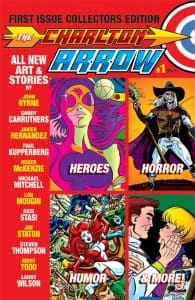
The rule, these days, is the work I’m doing at a small start-up called Charlton Neo, where a small group of Facebook friends came together to revive the beloved, 30-year defunct Charlton name with new stories and art, created not for the money (whew, talk about an understatement!) but for the pure love of the material. What started as a fun little small print run comic book is slowly evolving into an entire line, featuring new stories by old timers like me and a slate of new talent that is, frankly, knocking my socks off with what they’re doing. I’ve written about 130 pages of new material (and counting!) for the Charlton Neo books in progress, from anthology titles in genres from Western to horror to funny animals, as well as two issues of Paul Kupperberg’s Secret Romances, a romance anthology that proves “happily ever after” isn’t what it used to be.

As with Crazy 8, I can’t believe the array of talent I get to work with at Charlton Neo (do please check us out at CharltonNeo.blogspot.com; you’ll be impressed, too). Crazy 8 and Neo are both, without question, labors of love…possible, paradoxically only because of the paradigm shift in publishing that has, in other ways, affected many of us in negative ways. Would I ever want to go back to the old ways? In some regards, maybe…except that would also mean losing the breathless excitement and wonder of being part of two such amazing, dynamic creative communities. And while there are struggles even in that, just as I’m sure Bubbe would never have wanted to return to the shtetl despite the hardships of emigrant life in Brownsville, Brooklyn, I’m happy to take up residence in this New World in which I now find myself.

So, paradigms, keep shifting. We’ll adapt. If a 4-foot-something tall little Jewish woman who came to the U.S. from the middle of nowhere without knowing the language or customs could do it, I suppose I can too.

Funny books? We got you covered!

Almost three years ago, as Crazy 8’s second (one could even say “sophomoric”) release, we put out a zany little book about a duck-headed man and his bizarre, disjointed, hilarious quest to save the universe. That book, of course, was No Small Bills, which became a NOOK bestseller right out of the gate. Apparently people like to read funny stuff–who knew?

A year later, our avian-altered friend was back for more wacky hijinks in a second novel, Too Small for Tall.

Now, two years later, it’s time to saddle up and ride out yet again, because DuckBob Spinowitz is coming back! The third DuckBob novel, Three Small Coinkydinks, will be out later this month—but you can ooh and aah over the cover starting now!

Coinkydinks coverC

There, isn’t it pretty?

Not enough for you? How about a small sample to whet your appetite? Read, enjoy, gaze longingly at the cover some more, and watch for the book’s debut coming soon!

*   *   *

Meanwhile, I’m outside my old office. Should I go in? Should I tell my old boss, Phil, that I want my old job back? Should I grovel? Should I just stroll in like I own the place, say, “Yo, Phil, how’s it hanging? I was busy saving the universe and all but that gig got old so I figured I’d swing on back, you don’t mind, do you? And hey, can you grab me an espresso? I’ll be at my desk,” and see how long it takes anyone to wonder what I’m doing back or to point out that I may not actually work there again? I’m pretty sure I saw this movie years ago and it worked pretty well, especially for Teen Wolf and Supergirl.

Thing is—thing is, now that I stop and think about it, I hated my old job. Really hated it. All I did all day was scroll through screens on my computer, click a bunch of boxes on and other ones off, submit the form, and then repeat the process. It really didn’t seem to make much difference which boxes I checked, either. I know because I got bored after a while and started doing patterns, just like I used to do on the old standardized tests back in school. Which might explain why I almost got held back a grade twice but the NSA wanted to recruit me right out of middle school. So I used to check boxes in squares and rectangles, triangles and rhombuses, fleur-de-lis and stars, spirals and ankhs and infinities and subway maps. Nobody ever complained, at least to me, but I’m pretty sure we destabilized a small third-world company and brought a busload of tourist gamblers back to life. That’s bound to balance out whatever else happened, right?

Even if it does, though, can I really stand to go back to that? I mean, I saved the universe, man! I fought off an alien invasion! I stopped a galactic menace with nothing but taffeta and taffy! I fried a killer shrimp! After all that, how’m I gonna be able to survive working in that tiny little cube again, hunched over that tiny little screen, clicking buttons?

Wow, I had no idea just how much my old life sucked. Good thing I haven’t bumped into anybody I know yet—that’s the thing about being this distinctive, it’s not like my old friends and former co-workers could walk past and think, “Huh, weird, another guy who was modified by aliens and given the head of a duck just like DuckBob, what’re the odds?”

Which is, of course, right when a hand lands on my shoulder. A big, meaty hand, caught up in the cuff of a dark suit. And there’s the rest of the suit behind it, along with a white shirt, a dark tie, a dark hat—

—and a pair of dark sunglasses.

“Mr. Spinowitz?” It’s a surprisingly high voice for such a big guy, and it quavers a bit at the end. “I need you to come with me.”

Crazy Good Stories